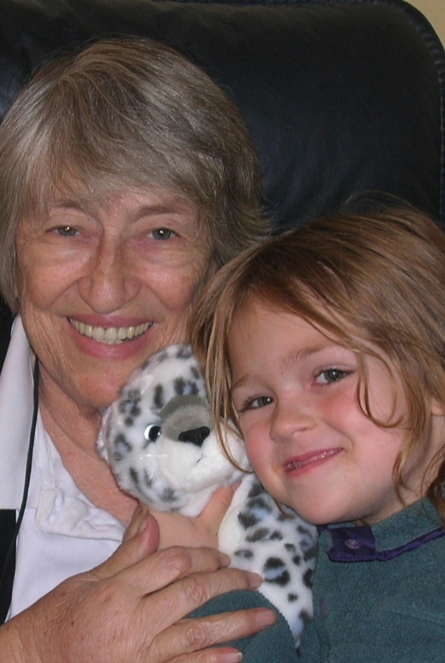
Jean S. Calhoun, March 20-1927 – January 25, 2012 (with her granddaughter, Caileigh Raine Calhoun, daughter of my brother Crede and sister-in-law Carol)
With me holding her hand, streaming into the last seconds of a four month long, unwinding process, my mother passed away last Wednesday, at 1:00pm, and, did so in her home, as she had both wished and planned for.
There is a great deal I could say about my relationship with Jean, who I usually just called mom. I spent a great deal of quality time with her over the twenty years here in Cleveland, after I returned. We were both Fabian Social Democrats–although she would tell you she remained an “Adlai Stevenson Democrat,” whereas I would harken farther back to the 17th century and tell you I am a Digger. We managed to eat up great gobs of our time together in our lamentations on the state of current events; oh, and decrying also–whatever–year’s dashed Cleveland sports hope was then unfolding.
Even a neutral observer could pick out the extraordinary nature of our mother-son relations–for the simple reason that such an opportunity is likely to be realized when two fiercely intelligent, and curious, and sophisticated, sensibilities are set upon each other as friends in adulthood. (Then, you put in the time.) I had occasion many times to remind her I was like her, and was, like her father, self-taught and a lifelong student.
(Because the process of interpersonal knowing is one of a handful of subjects I am most focused on, and its procedures are enacted as a matter of course, almost everything else about my mom is in the context of the vigorous inquiry I waged over two decades.)
At the same time, it’s complicated too: we worked through a lot of our ‘stuff’ at the beginning (in the early nineties,) moved as a family through the suicide of my twin brother Tim, got through her first cancer year, went through other intense stuff. And: then there was the time I dropped by to visit on a whim and ended up saving her life. Our relationship was, for her, at exacting moments, bittersweet. I suppose it had to be so for one of us.
So, yup, it’s complicated, yet our relationship was complicated in the way poetry and music come to be deeply summed. This was very cool and the consequence is that I can access my mother’s sensibility by accessing her resonant facts, facts which remain easily found in myself.
This is the true joy in life being used for a purpose recognized by yourself as a mighty one; the being thoroughly worn out before you are thrown on the scrap heap; the being a force of nature instead of a feverish selfish little clod of ailments and grievances complaining that the world will not devote itself to making you happy. George Bernard Shaw
Speaking of Shaw, my mom sorted her own version of the hundred versions of the one religion, describing it to me one day as being, in the main, sensual and oceanic.
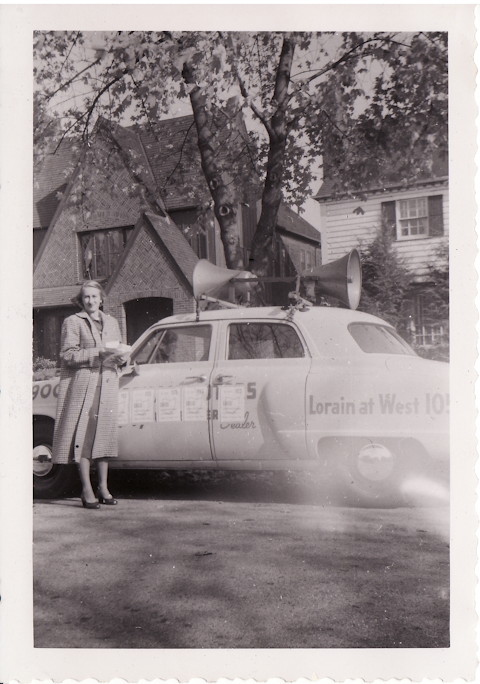
My mom in 1952. Activist in the 'Constitutional Party' Project
Jean S. Calhoun, a trailblazing college administrator and educator, passed away at home after a short illness on Jan 25, 2012. Mrs. Calhoun was the first female Vice President of Case Western Reserve University, serving as Assistant Vice President of the University between 1974-1982. She finished her career as Associate Vice President For Academic Affairs, retiring in 1988 after being named the university’s first female Vice President Emerita.
She began her career as a teaching fellow at Western Reserve University, earning her masters in English there in 1959. Later she was a lecturer on the faculty of the English Department until 1966. At that point she served as a senior associate on The Heald Commission, and co-wrote and edited the final report that recommended the merger of Western Reserve University with Case Institute of Technology. From there, she became a special assistant at the new university, and later Assistant Dean, and then Vice Provost.
She graduated magna cum laude from Bryn Mawr College in 1948, after graduating as Valedictorian of Batavia High School in Batavia, New York.
She and her former husband moved to northeast Ohio in 1951. She was active in the humanities and libraries, and served on the Ohio Humanities Council from 1972-1979, including a term as its Chairperson between 1976-1979. She served on the board of the State Library of Ohio between 1985-1992, and served as Chairperson between 1986-1990. She was invited on several occasions to participate on the Grant Review Panel of the National Endowment of the Arts. She was an Advisory Trustee of the Cleveland Music School Settlement between 1979-1992.
After co-authoring the Final Report of the Heald Commission in 1967, Mrs. Calhoun contributed to various studies in the humanities, and she gave the Jennings Lecture in 1975 for Martha Holdings Jennings Foundation. In her retirement she wrote for Shaker Magazine, where she resided after 1977. She also published on a wide range of topics in CWRU, the alumni quarterly. She co-authored and edited The Library and Its Future on behalf of CWRU in 1989.
She traveled widely, and remained in special affinity with the country and people of Greece. A sportswoman, she loved golf and tennis. She was an optimistic enthusiast of the Indians, Browns, and Cavaliers. Retirement freed her to become a very fine chef and flower gardener. Above all she was a lifelong devotee of the arts and classical music. She was a decades-long patron and supporter of The Cleveland Orchestra and Musical Arts Association. (Stephen Calhoun)

enjoyed reading about your mum