The coniunctio happens in the underworld, it happens in the dark when there is no light shining any more. When you are completely out and consciousness is gone, then something is born or generated; in the deepest depression, in the deepest desolation, the new personality is born. When you are at the end of your tether, that is the moment when the coniunctio, the coincidence of opposites, takes place (Mary-Louise von Franz).
Mary Halvorson and my friend Susan Alcorn, the latter among a handful of pedal steel guitarists playing experimental jazz.
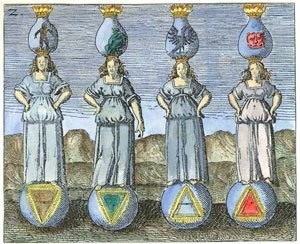
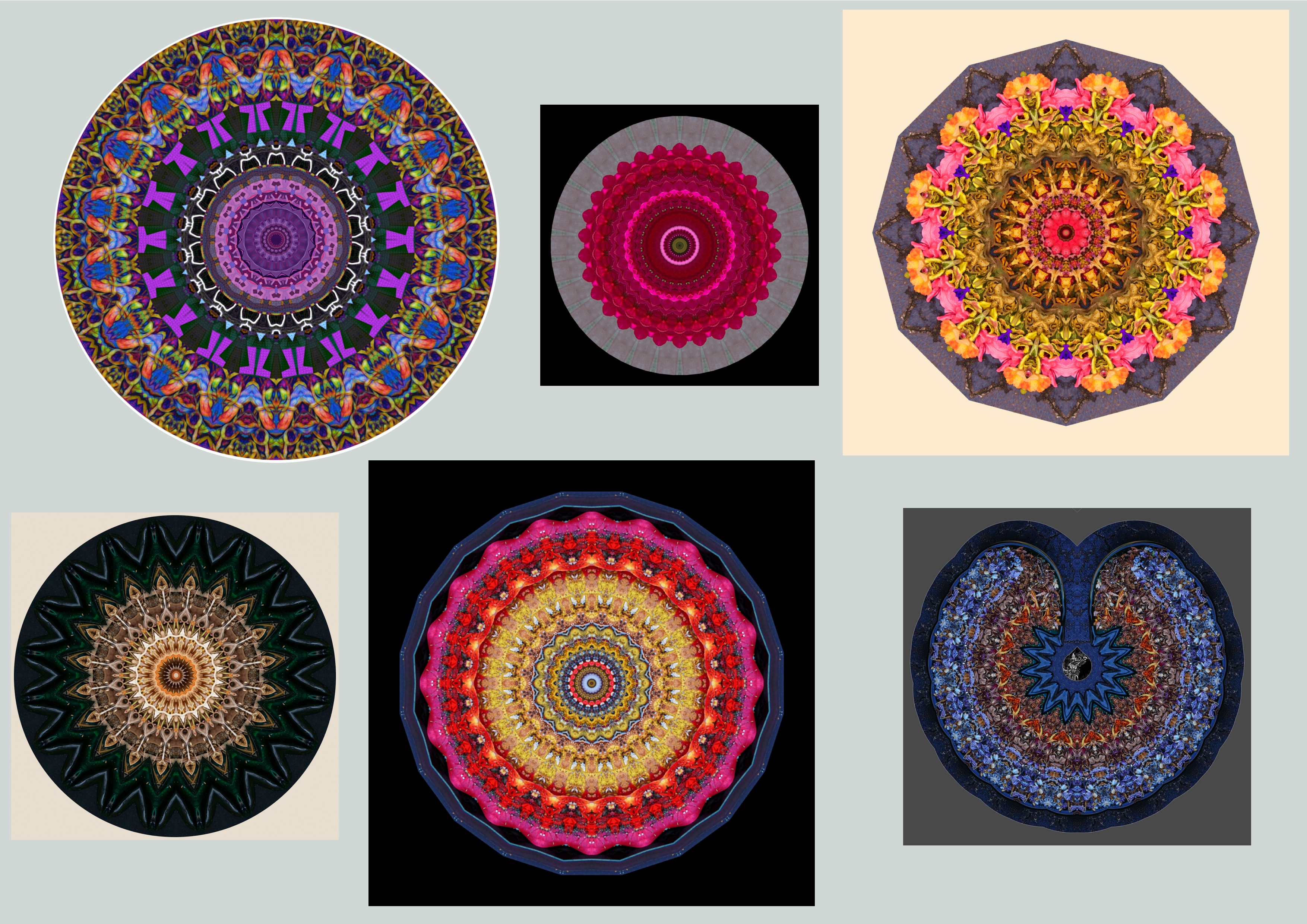
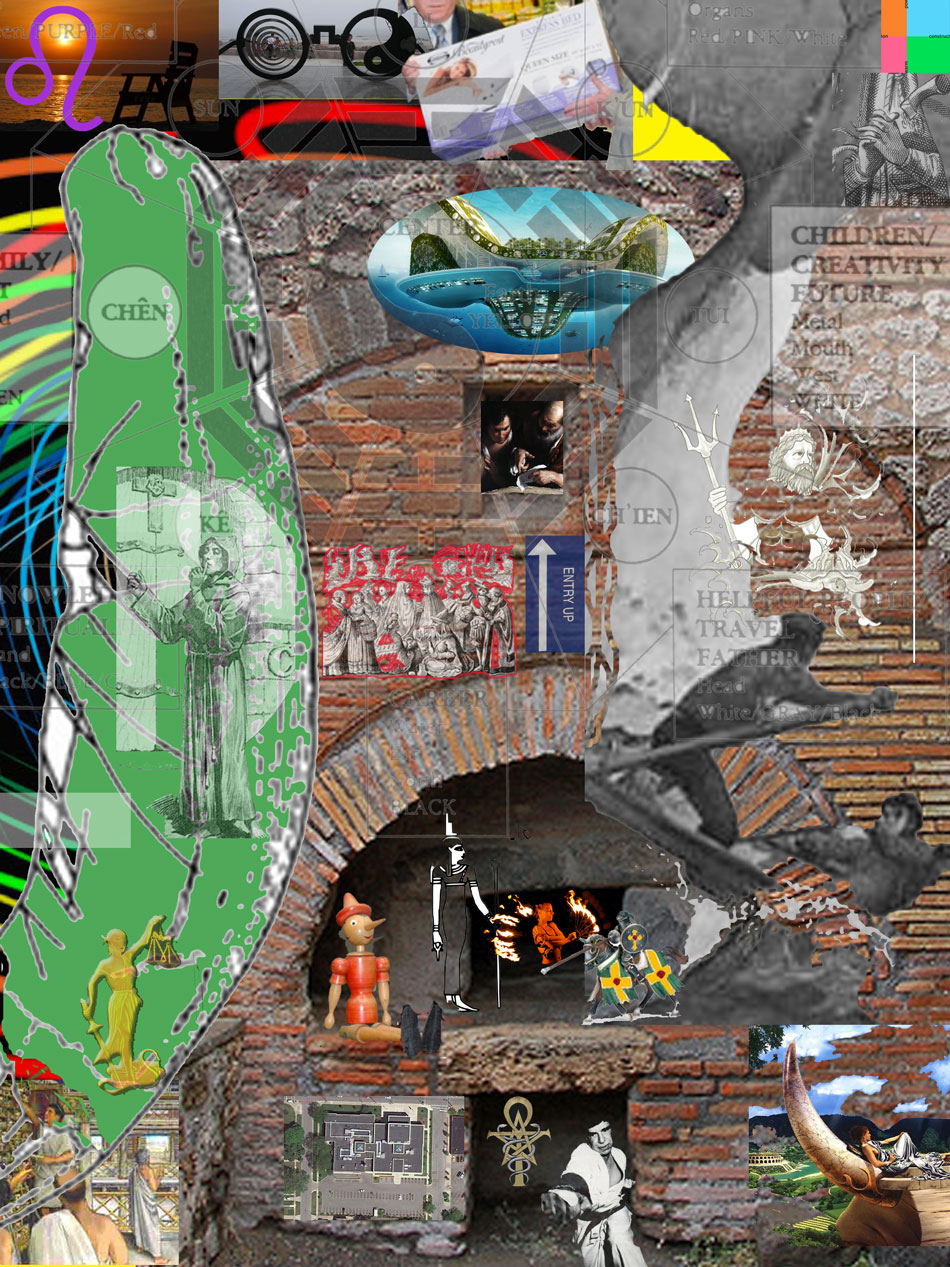
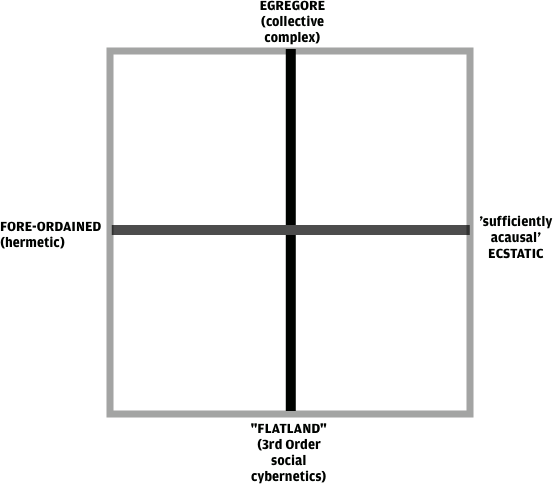
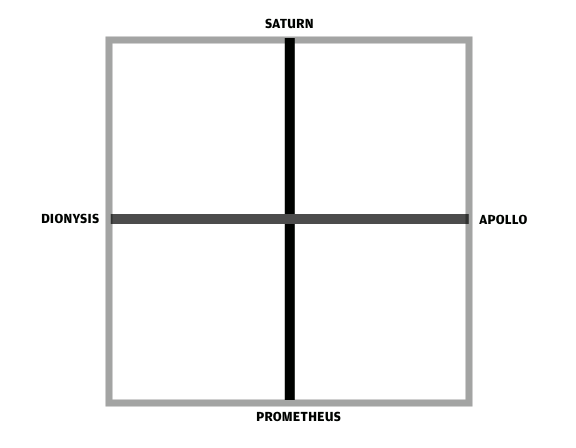
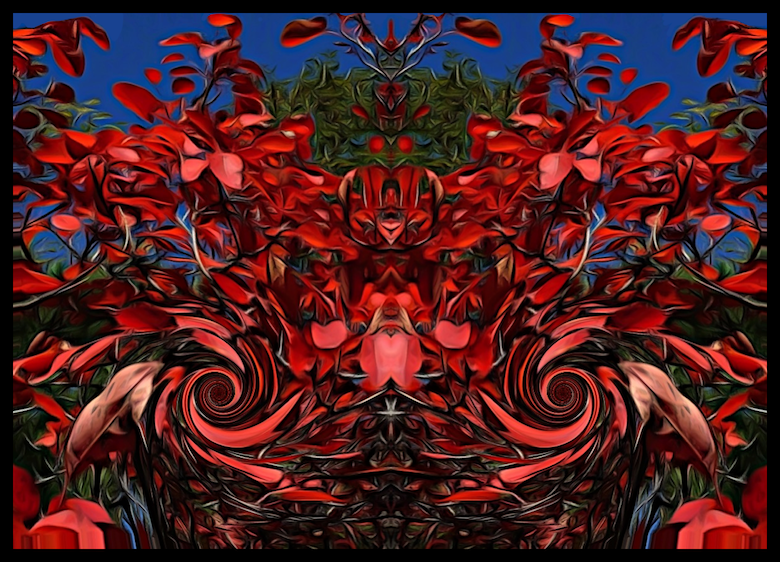
A Brief Schema of the Reformation of the Contemporary Dark Egregore (2018) Stephen Calhoun 36x36a
A track was created and dedicated to Ms. Alcorn, in 2011, on the Kamelmauz (my) recording Poor City.
The coniunctio happens in the underworld, it happens in the dark when there is no light shining any more. When you are completely out and consciousness is gone, then something is born or generated; in the deepest depression, in the deepest desolation, the new personality is born. When you are at the end of your tether, that is the moment when the coniunctio, the coincidence of opposites, takes place (Mary-Louise von Franz).
The shuttling to and fro of arguments and affects represents the transcendent function of opposites. The confrontation of the two positions generates a tension charged with energy and creates a living, third thing—not a logical stillbirth in accordance with the principle tertium non datur but a movement out of the suspension between the opposites, a living birth that leads to a new level of being, a new situation. (C.G.Jung)
What can you discern about your reflection in the archetypal ensemble?
Contact – Mystery
Code – Gnosis
Action – Love
How might you overcome your isolation by gauging yourself in universal modes of polarities?
Ken Warren (from notes to a presentation, Repairing the Opposites, Doubling Stars, Turning Swine Into Pears, given by Ken Warren and Stephen Calhoun at The Analytical Psychology Society of Western New York, December 12, 2014)
Proverbs 3:16 tells us: “Length of days is in her right hand; and in her left her riches and honour.”
Stage One: Survivor/Transitional-Object
Stage Two: Truster/Trickster
Stage Three: Unscrupulous Competitor/Hero
Stage Four: the Virtuous/the Shadow
Stage Five: Materialistic Analyst of Things/Anim(a/us)
Stage Six: Empathizer with Every Person/Wise One
Stage Six needs desperately its unconscious complement, the Archetype of Meaning, a voice of wisdom from the depths. The Sequence of Archetypes in Individuation, James Whitlark
I traced a circle on the ground,
It was a mystic figure strange
Wherein I thought there would abound
Mute symbols adequate of change,
And complex formulas of Law,
Which is the jaws of Change’s maw.
My simpler thoughts in vain had stemmed
The current of this madness free,
But that my thinking is condemned
To symbol and analogy:
I deemed a circle might condense
With calm all mystery’s violence.
And so in cabalistic mood
A circle traced I curious there;
Imperfect the made circle stood
Thought formed with minutest care.
From magic’s failure deeply I
A lesson took to make me sigh.
Alexander Search (Fernando Pessoa)
July 30th. 1907. [1]
Twin Study I. (2016) Stephen Calhoun
“I have always been particularly interested to see how people, if left to their own devices and not informed about the history of the [Mandala] symbol, would interpret it to themselves. I was careful, therefore, not to disturb them with my own opinions and as a rule I discovered that people took it to symbolize themselves or rather some- thing in themselves. They left it as belonging intimately to themselves as a sort of Creative background, a life-producing sun in the depths of the unconscious mind. Though it was easy to see that it was often almost a replica of Ezekiel’s vision, it was very rare that people recognized the analogy, even when they knew the vision -which knowledge, by the way, is pretty rare nowadays.” C.G. Jung, The Terry Lectures
Gemini with respect to psyche, broadly conceived, brings into ‘co-motion’ the regressive chthonic and the transgressive totality. At a higher, finer grain, the twin–as image–represents the prospect of the alchemical marriage. As Gemini, its transformative operations take up scattered elements and brings these back into order.
The Twin is the archetype of recursion. With this repetition, the twin holds the potential for any reassembly, be it playful or serious or trial-and-error. The gesture bends back. Its sound is the yielding reassembly of harmony, via sonic palintropos.
Overnight contents separate, and come to be stirred back together. Gemini.
Twin Study II. (2016) Stephen Calhoun
What gets hatched at night, in the lunar phase?
Sometimes the organic pair is subject to fierce moralizing. For example, what of the facile distinction oft made between thinking and feeling, or, head and heart? Their deep structure is blanketed. Heavy associations weigh one of the poles down, like a cinder block tied to a victim’s ankles.
This is like mashing two things together, pulling them back apart, and, finally deciding one has to go! The shadow of the twin is found in the demonization and suppression of the organic opposite, in the making of, and, next, sanctioning against this fallen angel, and finally turning it out (or away.)
(Gemini forensics! Where is the antimony buried?)
A theory of recurrence, such as that of Yeats, in exemplifying the cycling between lunar Antithetical and solar Primary tinctures is a twin study. Fusion with the ideal, and disavowal of the organic opposite provides for the violent dismissal and covering over of this other side.
Where feeling reigns ‘apart,’ this may move vast numbers of voters toward the light cast by the idealized father, concretized to be, well. . .
Leaving, returning. Turning back. . .
[2]
Uncovering bends back the cover.
They do not understand how, though at variance with itself, it agrees with itself. It is a backwards-turning attunement like that of the bow and lyre. -Heraclitus
It lifts up the buried: part, aspect, inferior. The twin is at once separate and a unifier.
Gemini’s hidden holistic relationship to all the houses, tracks the pairings which are the relations discoverable in all projections. Cast from to you.
The phenomena of the twin anchors the resurrection and recovery of the opposites.
see:
The Rhizome and the Flower: The Perennial Philosophy, Yeats and Jung, By James Olney
The Harmonia of Bow and Lyre in Heraclitus Fr. 51 (DK)
Jane McIntosh Snyder, Phronesis Vol. 29, No. 1 (1984) JSTOR
[1] Sacred Geometry of Being: Pessoa’s Esoteric Imagery and the Geometry of Modernism
Patrícia Silva McNeill, Pessoa Plural 6, 2014 (pdf)
[2] Beyond Fascism: W.B. Yeats’s A Vision and the Complexities of His Authoritarian Politics
Justin Abel, Eastern Washington University (pdf)
Virgins with T-squares
and compasses, guarding
the heavenly blackboards.
And the angel of numbers
reflective, flying
from the 1 to the 2, from the 2
to the 3, from 3 to the 4.
Dead chalk and sponges
rule and erase
the light of the heavens.
Not the sun, moon or stars,
not the sudden green flash
of the lines and the lightning,
nor the air. Only haze.
Virgins without T-squares,
without compasses, weeping.
And on the dead blackboards,
the angel of numbers,
lifeless, laid out
on the 1 and the 2
on the 3, and the 4…
(The Angel of Numbers, Rafael Alberti, translated by Jerome Rothenberg)
Only gradually did I discover what the mandala really is: Formation, Transformation, Eternal Mind’s eternal recreation. And that is the self, the wholeness of the personality, which if all goes well is harmonious, but which cannot tolerate self-deceptions. (Carl Jung, Memories, Dreams and Reflections)
So you see, in a moment during a patient’s treatment when there is a great disorder and chaos in a man’s mind, the symbol can appear, as in the form of a mandala in a dream, or when he makes imaginary and fantastical drawings, or something of the sort. (Carl Jung)
A mandala spontaneously appears as a compensatory archetype during times of disorder. (Carl Jung) [h/t carljungdepthpsychology.wordpress.com]
There are four notes, (suppose these to be notes-to-self,) that come all the way up and to the center when I reflect on why it is that the mandala has taken over my creative practice.
These are simple notes too, and these represent the starkest capture.
(1) Depressed at the rise of Trump and nihilist Trumpism.
(2) Demoralized at the failure to satisfactorily meet my worldly obligations.
(3) Understand the inner order reflected in the enthusiasm for manifesting mandalas is only a potential reordering, and the proof of this is in the outer disorder.
(4) Unhappy and tired in the wake of the sharp arrivals due to the constant processes of death and loss that have struck over the past years.
I wear my depression very lightly. Optimistic. Youthful outlook.
My contemplative practice is the first balancing act. I note my creative agency is powerful too, yet, I haven’t a clue as to what is going on, except to distrust to a niggling degree that I am on the right track. I have to suppose this distrust of my own creativity is something to work through at this rather early yet auspicious juncture. This has nothing to do with my personal qualification of my creative product, it has to do with what this feels like in the context of outer disorder. It comes as no surprise that powerful inner motives are working me over a bit at the expense of outer order.
There is in this a fraught paradox: betwixt the rush and rushing forward of inspiration and ideas, and, the yet to be shaped command to, in actuality, set this aside for the purpose of getting the house in order.
The energetic aspect is clear enough to me. After all, I am not painting mandalas or setting fine grains of sand to a blueprint. Once the mathematics clicked for me, the opportunity presented itself fully: there are all sorts of archival photographs which may lend themselves to manipulation. These photos now come up again to be resuscitated.
(One image in this post presents how this is done.)
Still, am I creating mandalas? What is coming up and out seem to me reductions too, and also pieces symbolize eyes and sphincters. The images that consist of patterns of concentric circles nevertheless are unitary objects. Also, the direction of experimentation already is disrupting the simple concentricity.
Yes, creating mandalas is soothing. It occurs to me also that this is of a piece with my artistic mission, and, this also puts in 2nd order cybernetic relations a deeper aspect of the kitschy facile gimmicks I am employing as propositions in various visual experiments. Those relations are about learning.
As for my own psyche, I’m waiting for the dream. The only dream that recently arrived was optimistic, and this seemed to me its fault.
A magical, sacred, and perfected environment of the Buddha, which
denotes the order and harmony of an enlightened mind, and built on their
perfect wisdom. The purified circle of an enlightened being, an environment
wherein the endless compassion of the enlightened one is expressed.”
(C.G. Jung: ‘Mandala Symbolism’)
Oh, there’s this–see its opening and conclusion:
Theoretical Foundation for Jung’s “Mandala Symbolism”
Based on Discrete Chaotic Dynamics of Interacting Neurons
Vladimir Gontar (International Group for Chaos Studies at Ben-Gurion University of the Negev, Beer-Sheva, Israel)
One is the loneliest number that you’ll ever do
Two can be as bad as one
It’s the loneliest number since the number one
No is the saddest experience you’ll ever know
Yes, it’s the saddest experience you’ll ever know
‘Cause one is the loneliest number that you’ll ever do
One is the loneliest number, whoa-oh, worse than two
It’s just no good anymore since you went away
Now I spend my time just making rhymes of yesterday
One is the loneliest number
One is the loneliest number
One is the loneliest number that you’ll ever do
One is the loneliest
One is the loneliest
One is the loneliest number that you’ll ever do
It’s just no good anymore since you went away
(Number)
One is the loneliest (number)
One is the loneliest (number)
One is the loneliest number that you’ll ever do
Nillson/Edwards
I’ve been making mandalas. This represents a regression in both the terms of psyche, and, my own growing artistry. This is a local reconfiguration for the sake of doing different experiments concerned with the singularity given by the whole “O,” the eye, the core, the centrifugal oneness. Empirically, mandalas don’t grip the viewer for the same reasons a complex work chock full of partially hidden patterns and relations grip someone. Yet, as the dictionary tells us, mandala means magical circle.
Yet, everybody at times enjoys partaking of some regression! Going backward sometimes means moving back in time toward innocence, or moving to a previous point at which point the bad mojo had not arrived, or been elected.
Mandalas are the warm blanket of the world of created manmade forms. My mandalas…
Read more: Three Dog Night – One (is The Loneliest Number) Lyrics | MetroLyrics
Whoever the “rapist of Persephone,” whether it be Cephisus or Dionysus–and the Eleusinian Mysteries were carried out near the river Kephisos, indicating a link between the two gods–the disordering attack must be reexperienced and lived through, else the redemption of soul will not progress. The way is as much through chaos and death as it is through ecstacy and joy. (Nathan Schwartz-Salant, Narcissism and Character Transformation, p145.)
But, when the narcissistic structure escapes its trial, and the public figure soaks up the larger-than-life projections, projections based in the similar refusal or resistance to soul-making regression, then there is no depressive breakthrough, there is just the steady march to psychzoid splitting.
W.H. Auden:
Patriots? Little boys,
obsessed by Bigness,
Big Pricks, Big Money, Big Bangs
Without a blow to inflated phallic pride no wisdom is possible. – Eugene Monick
There’s a lot of trending collective identifications streaming wildly about as the USA aims to land its messy electoral democracy on the landing strip November 8. I ask myself what the point of my own research (into folk political economies cast under the light of archetypal psychology,) is when I also sense that it is almost pointless to reveal my abductions under the current circumstances.
That the potential battle of all against all is fantasized by ‘white nationalist manly types’ as arriving at an extremely violent battle of all against all, at a literal civil war, because this is the only way the joined forces of global finance, Democratic and GOP party establishments, non-white races and ethnicities, feminists, so-called social justice warriors, cultural marxists, environmentalists, may be finally defeated, stitches together a prospective tyranny of what is, by definition, a minority.
Practically, then what? Psychologically, might such warriors actually contemplate being killed for such a cause?
I remind myself that those with the time to fantasize always are pointing at the conflict between different utopian wishes for be-all and end-all social engineering. On a blog I have been visiting for over a decade, the ethos of its main commenters decries the utopian dreams of Mrs. Clinton ‘and her kind,’ without any ability to sense that all anti-utopias are nevertheless prescriptions for utopian engineering.
Those utopian dreams are, obviously, projections. The infantile /nobody is going to tell me what to do anymore/ is joined in our body politic with the masculine’s damaged feel for its lost potency.
So it seems that the ultimate fantasy is to return to manly swordsmanship. Not in the least incidentally, this mimics the dream and aims of another ripping collective of damaged men, daesh/ISIS.
‘obsessed by bigness, big wins, “winning so much winning will become boring.” Tyranny of the chaotic masculine, of the paradoxically powerful impotent tiny men, would beckon, except this collective thrust is about to be turned back.
Whether this particular collective complex will turn back into its self enough to own this new trial, and to begin to individuate, is the deeper question.
Numerous complex specifics of the current societal context in the USA aren’t supportive of this psychological shifting in the underlying currents.
(To me, there are significant questions about whether the archetypal framework for understanding conspecifics of collective change can actually do developmental duty here.)
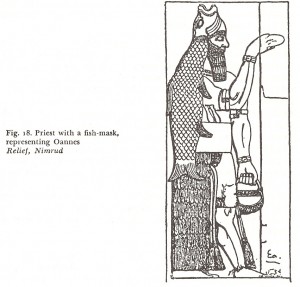
The journey of Moses with his servant Joshua is a lifejourney (it lasted eighty years). They grow old together and lose the life-force, i.e., the fish, which “in wondrous wise took its way to the sea” (setting of the sun). When the two notice their loss, they discover at the place where the source of life is found (where the dead fish revived and sprang into the sea) Khidr wrapped in his mantle,48 sitting on the ground. In another version he was sitting on an island in the midst of the sea, “in the wettest place on earth,” which means that he had just been born from the maternal depths. Where the fish vanished Khidr, the Verdant One, was born as a “son of the watery deep,” his head veiled, proclaiming divine wisdom, like the Babylonian Oannes-Ea (cf. fig. 18), who was represented in form and daily came out of the sea as a fish to teach the people wisdom. (pp 197-198, C.G.Jung, Symbols of Transformation)
July 7: www.inquisitr.com/3283007/ohio-ufo-chased-by-military-helicopters-gigantic-un-earthly-ufo-filmed-over-cincinnati/
Just the other day, I seem to have taken a photograph in our garden of a UFO no bigger than a marble.
So if Hillary Clinton is running for president, why is she talking about UFOs?
Part of the answer may be that the Clintons have ties to a network of influential people who have lobbied the government to disclose the truth about UFOs. This includes the late millionaire Laurence Rockefeller (who funded John Mack’s research) and John Podesta, the chairman of Clinton’s campaign and a long-time disclosure advocate.
But there may also be a broader cultural cycle at work. Sociologists such as Christopher Partridge have suggested that disenchantment leads to re-enchantment. While secularisation may have weakened the influence of traditional churches, this doesn’t mean that people have become disenchanted sceptics.
Instead, many have explored alternate spiritualities that churches had previously stigmatised as ‘superstitions’ (everything from holistic healing to Mayan prophecies). The rise of scientific authority may have paradoxically paved the way for UFO mythology.
A similar change may be happening in the political sphere where the language of critical thinking has been turned against the scientific establishment. In the 1960s, Congress deferred to the Condon Report.
Today, conservative politicians regularly challenge ideas like climate change, evolution and the efficacy of vaccines. These dissenters never frame their claims as ‘anti-science’ but rather as courageous examples of free inquiry.
Donald Trump may have been the first candidate to discover that weird ideas are now an asset instead of a liability. In a political climate where the language of reason is used to attack the authority of science, musing over the possibility of UFOs simply doesn’t carry the stigma that it used to.
Joseph P. Laycock, Assistant Professor of Religious Studies, Texas State University.
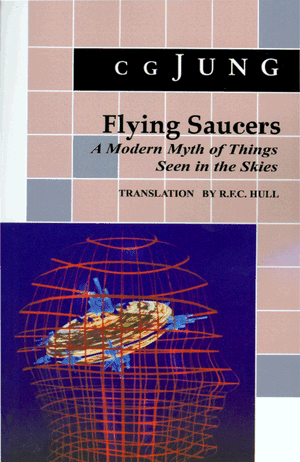
the problem of the Ufos is, as you rightly say, a very fascinating one, but it is as puzzling as it is fascinating; since, in spite of all observations I know of, there is no certainty about their very nature. On the other side, there is an overwhelming material pointing to their legendary or mythological aspect. As a matter of fact the psychological aspect is so impressive, that one almost must regret that the Ufos seem to be real after all. I have followed up the literature as much as possible and it looks to me as if something were seen and even confirmed by radar, but nobody knows exactly what is seen. In consideration of the psychological aspect of the phenomenon I have written a booklet about it, which is soon to appear. It is also in the process of being translated into English. Unfortunately being occupied with other tasks I am unable to meet your proposition. Being rather old, I have to economize my energies. Carl Jung letter to The New Republic’s Gilbert Harrison (1957)
The Symbol of the Hybrid Human/Alien Child in the Abduction Phenomenon: Rebirthing within the Psyche and the Psychosomatic Imagination
Robert J. Williams (pdf)
It was bound to happen some night and it happened last night. I had a dream with Donald J. Trump in it. As a longtime dream keeper and dream analyst, the dream with respect to psyche was transparent.
Scene 1
I climb the stairs of a house in an Frisco neighborhood. I’m on the way to help a friend with a rock band she is promoting.
I find her hanging out with the band in a bedroom. She’s sitting on the bed. The band of four hippie guys in their twenties is spread between a couch and a chair. I sit on the bed with her. She and the band are discussing ideas for a video.
“We have this great ’64 caddy. Maybe just shoot a video with us singing and playing as we drive around?”
She thinks for a moment, looks at me, turns back to the band and suggests,
“Good, but I can top it all off.”
“How so?” I ask her.
“I know Donald Trump. He can be the driver.”
Turning my head toward my friend, the bright and darkly pretty gal on the bed next to me, I raise my eyebrows in a silent, ‘You do?’
“Should I call him, see if he is available?”
The band collectively chuckles, and nods their assent.
After a few minutes on the phone, she ends the call, and announces, “He’ll be right over.”
(Surprise is the feeling tone.)
Scene 2
We all get up and file out down the narrow front stairs. A big maroon 1964 hard top Cadillac sits in the driveway, parked head first.
As the group gets to the car, a black limousine pulls up to the curb, a drive gets out, walks to the rear passenger door, and opens the door for Donald J Trump. He is dressed in a blue suit with a bright red tie.
We hail him, and I move toward the driver’s side of the caddy. Trump has walked briskly and his tiny hand reaches the door handle before my own (ummm, large,) hand does.
“I got this,” he tells me.
We pile into the car, with the band taking over the back seat, and me between my lady friend, and, behind the wheel, Trump. I have the best view as Trump takes the keys from one of the lads and tries to figure out where the key needs to be inserted to start the car.
Leaning toward him, he backs me off,
“I got this.”
He eventually finds the ignition slot and starts the car. He gingerly backs the car out of the driveway onto the street. I think to myself, that Trump seems a bit nervous, seems like he hasn’t driven a car recently. The car slowly backs up until the rear wheels crunch against the opposite curb. Trump looks at me and glares.
He manages to get the caddy faced in the correct lane of the street, and slowly he drives away. Reaching a cross street, he turns right.
Scene 3
(The scene changes. The street we’ve turned onto is a circular cul de sac, but now it is winter, and there is a little bit of snow on the ground and on the road.)
Trump is obviously nervous now and being careful. The caddy skids for a moment and bumps the curb. Now, I give him a look.
“I got this.”
But, the caddy gets sideways. Although it isn’t stuck because of the snow, the curve of the street is such that there isn’t enough room to maneuver, so Trump steers the car up and over a curb and attempts to turn it around.
I turn toward the band in the back seat. One of the hippies gives me a thumb’s up. I turn toward Trump,
“Do you need some help?” With this appeal, I am sure he hasn’t driven a car in a long long time.
A bit frustrated, Trump glances toward me,
“I got this!”
Conscious capacity for one-sidedness is a sign of the highest culture, but involuntary one-sidedness, i.e., inability to be anything but one-sided, is a sign of barbarism. (C.G. Jung, Psychological Types)
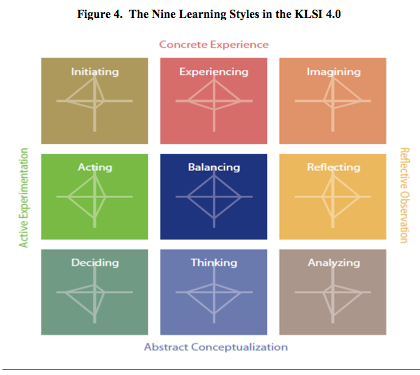
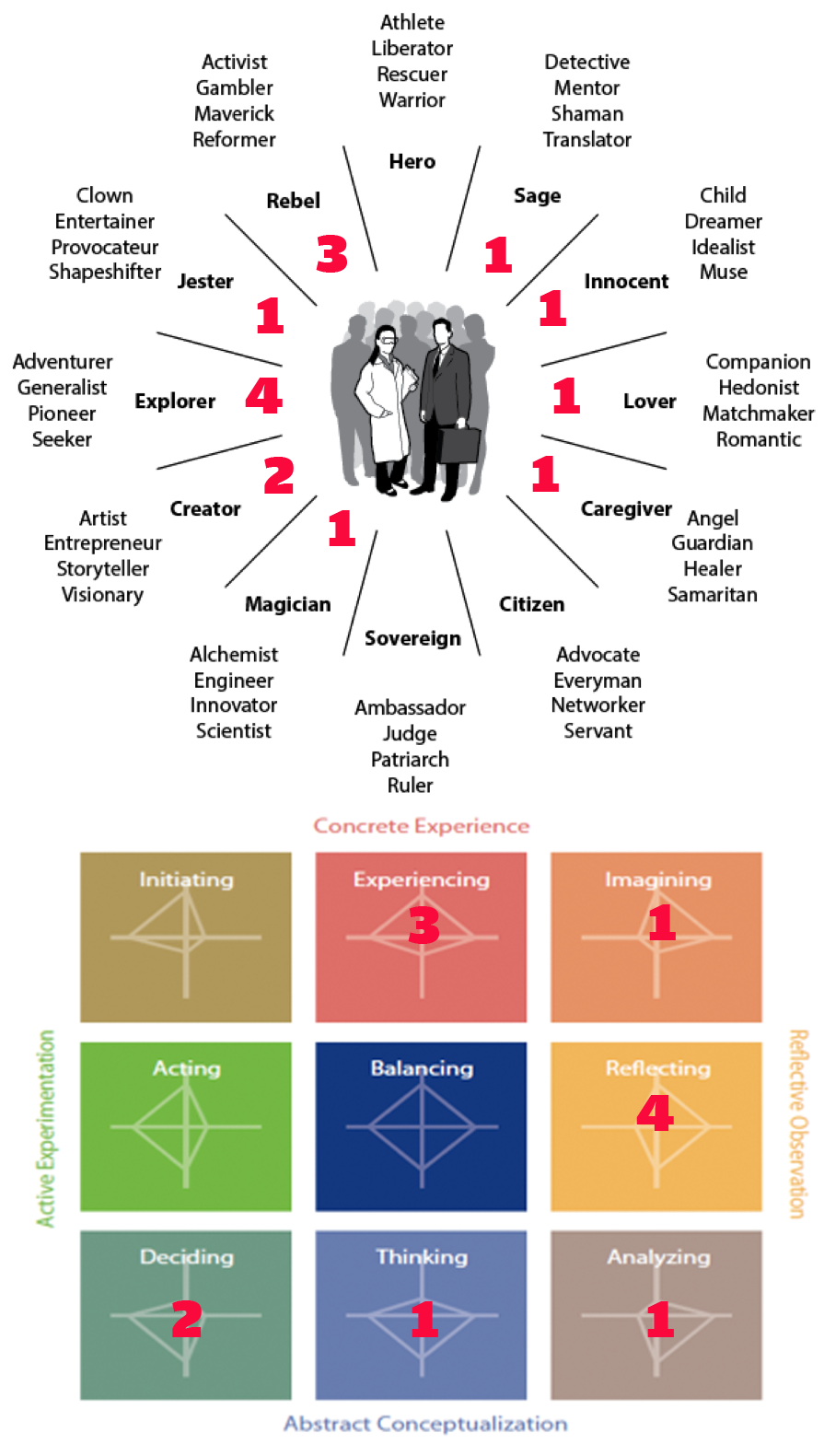
Print out this post to utilize the two assessment forms.
Archetype Axis
Reflect on the make-up of your personality and assign 15 total points to select archetypal aspects. The scale of the point system is graded this way:
4 points – most dominant expression of particular archetypal element
3 points – next most dominant expression
2 points – strong expression
1 point – mild expression
Use the following distribution protocol:
Assign 4 points once
Assign 3 points once
Assign 2 points at least once
Assign 1 point
Use no more than 15 total points.
Kolb Learning Style ‘array’
Reflect on the make-up of your personality and assign 15 total points to select archetypal aspects. The scale of the point system is graded this way:
4 points – most dominant expression of particular learning disposition element
3 points – next most dominant expression
2 points – strong expression
1 point – mild expression
Use the following distribution protocol:
Assign 4 points once
Assign 3 points once
Assign 2 points at least once
Assign 1 point
Use no more than 12 total points.
Example (my own)
note-I am misusing the Kolb Style array. However, my redeployment of it as a device for self-evaluation does provide me the means to better assert stylistic disposition in relationship to actual concrete learning contexts. The example here is generalized but takes into account–in a phenomenological sense–my real time introspective intuition on the nature of my own learning process. This is a more accurate process of evaluation than the formal instrument allows for.
In the USA, where guns pop off just as Jung suggested they would, and where the wounded masculine is amped and lashes out, nevertheless, there are hopeful signs.
I have been reflectingintuiting over the past six weeks on my relationship with Ken Warren, and, the nature of active creative sustained depth-full relationship. This has been, is, almost a prototype of grief framed by bittersweet finality. This is both a ‘hard’ thing and a very good thing.
As I grapple with a phenomenology of deep relationship, very little of what I have been shaping over the last few weeks is inflected by interactions brought up and out from an ongoing relationship. I have been focusing on the unique qualities of my relationship with Ken. The implicit irony given by conceptualizing without solidarity is not lost on me at all.
This schema depicts one view of generalizations oriented to a foundational perspective. In turn, it is taken from the most basic interpenetrating levels, levels identified and discussed by Ken and myself. This schema represents the hand of deep relationship oriented to co-creative exploration, taken from the unique fingerprint of our relationship. Every deep relationship expresses a unique fingerprint.
In my view, the hallmark of deep exploratory relationship is that it is relationship founded by the transformation of instrumental relations into core depth orientation and action. Deep relationship is noetic.
Deep relationship is ironic in several crucial senses. First, such relationships demand what I term ‘open time’ orientation for the sake of turning away utility, and turning toward exploration. This further means that deep exploratory relationships are not mainly normatively useful. Secondly, exploration itself requires ‘heuristical’ flex within the open time modality; and this is instigative of the negotiation and transit and transfer of meanings, and the recursive chatter which soon enough finds any granted perspective to be ‘ironic’ in the given relation to some other perspective.
Ken and I cycled through this second aspect precisely in the way that the, his, foreordained could encompass both traditionalism and naturalism whereas, my notional contingency would encompass both fortuity and emergent spontaneity. We discovered early on that the spirited verticality is entangled ironically with soulful horizontality. This crossing, so-to-speak, constituted the background frame to our wandering, experimentation, and exploration.
Third, the introduction of a profound ludic element to the core orientation is clearly ironically situated in the way playing around pulls time out of its linear contour, and, amplifies the timelessness of the first order intrinsic motive; which is to assert here how play is motivated by virtue of play being enjoyable for its own sake. This is a baroque way of describing the experience of combinatorial flow in our relationship.
“Wow, I can’t believe we’ve been hanging out for four hours!”
(email me if you want the Warren-Calhoun Matrix in pdf)
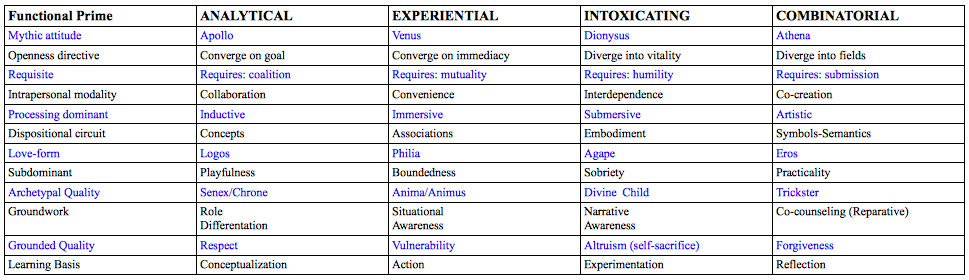
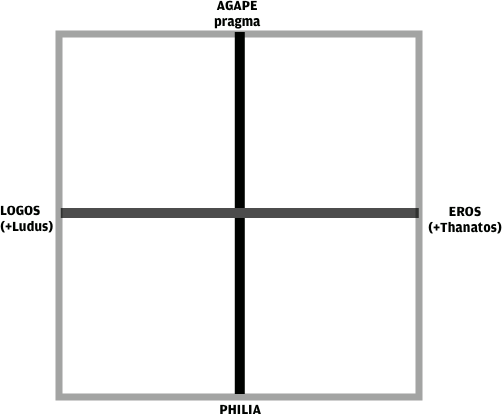
In my idiosyncratic and syncretic phenomenology of profound friendship, essential qualities of deep relationship are placed in the order of this matrix. The matrix proposes that such relationships possess qualities and dispositions of these types. Those qualities and dispositions in the flux of relationship are dynamic, whereas the apparent square form of the matrix is stable.
Typology given by the functional primes: A(nalytical) | E(xperiential) | I(ntoxicating) | C(ombinatorial)
In noting this, a relationship may be broadly typified. For example, Ken and my relationship was in the main Combinatorial, and its type in order was much of the time, C(IEA) The subdominant quality is an inferior quality, so our Combinatorial relationship could be very impractical. Although I have yet to conceptualize the dialectical primes and secondary polarities given in the matrix, it seems readily apparent that the basic oppositions are given in the pairings, C<>A, and E<>I.
Additionally, right now the rough appearance suggests the typology of the Analytical Psychology T/F, N/S, unequivocally associates with the relational primes:
Alas, all this is worked out without my favorite colleague and friend and co-explorer’s contemporary contribution. Our inquiry had begun to stir into these elements the liberated psychoastrology and the experiential learning theory of my colleague David A. Kolb.
Still, Ken was very jazzed by our recent inquiries coordinated by our mutual sense that some of the deep noetic structures of organizations, such as public libraries or suburbs, were literally secreted in the profound dyadic relationships of persons in those kinds of communities.
(My considerations here are surely novel in their relation to what is a very small normative literature about depth-in-relationships–found within the scholarship about management.)
One way to work with these ideas is to imagine a controller for your close relationships and then conjure how you sometimes manipulate its regulatory dials.
Intentional control regulates relational dynamics and core ‘co-performance’
Let me know what you discovered in playing around with the dials!
The Matrix itself could be larger, and more robust. Because our own relationship comprised our principle laboratory, in our collaborative deconstruction of my promethean puer, and of Ken’s anima problem, over the last year or so, we discovered a lot of shadowy elementals, darkened aspects, impersonal inversions, and hidden unconscious facts. Ken termed these occulted aspects. Those aspects obviously figure into, and would augment, the organization of the fuller set of generalizations of the qualities and dispositions of deep relationship.
All Hail the Center Pieces (S. Calhoun, 2015, 24x48h”)
Over the past few years I have not combined a vertical with a ‘flipped’ horizontal symmetry so as to synthesize the above stack.
Presumably, there is a transcendent function hidden in my (a) intention, or, (2) unconscious urge, because it goes from the two via the processual three to the whole four.
Two, plus two, next four.
odis tamquam fures et homicidas, tamquam specula celesti fulgore micantia mirare cogeris et amare.46
(you hate them as robbers and murderers; you love and worship them as mirrors reflecting a celestial light) dialog of Ficino
My artistic sensibility admits as much, so, not surprisingly, the visual result is completed by the viewer, and, as well, the dialectical stasis captured in the moment of the viewer’s experience is also ‘half’ in the sensibility of the viewer. I term this: diastasis. The basic formulation could be enumerated, one, two, three, four; so this is most simply: creation, field, experience, engagement. The hidden bridge in the (social) cybernetic sense is the viewer’s abduction, which is the means for the viewer ‘reason-experiencing’ to the best explanation of their experience of the forms hidden in plain sight.
As the creator, I do not code those abductions into the visual field (piece.) Rather, their animation is contingent on the four-fold, as is this ‘adding up’ to: mirrors reflecting a celestial light.
This is, from certain perspectives, a very serious business!
(I would use different terms than Adorno, yet it is self-evident to me that the viewer completes the engaging experience with her own cultural conditioning. Because my aesthetic is intentionally underdetermined as a matter of the constitutive generativity underlying both creative process and artistic product, my aesthetic also greatly underdetermines the programmatic encoding. I like to think this lack of masterful coding sets the piece free from being only a simple message.)
Loss of a person, of a close frriend or of a family member, presents a challenging process which won’t let go as it impels me through its requisite travail.
At the same time, the outward conventions of concern and courtesy basically allow for a restoration of human contact in the collective terms of concern and courtesy, and, sure, in the terms of grief and mourning.
These expressions are helpful, even as the expressed kindnesses and concerns seem to me to reach around the really bare, and profoundly forward-pitched facts. Of course, I would do the same thing, in approaching somebody’s loss, in approaching a ‘death in the family.’ Except, at the same time, I would be always holding back my usual, or my habitual, curiosity.
I would reign in my researcher’s soul.
What is actually going on?
I previously mentioned, or I think I did so, that in the weeks between meeting Ken for the first time and our second meeting, he reported to me that he had read my entire web site and blog. At the time he made this report, I didn’t know really what kind of ‘reader’ was Ken. Still, I was very impressed because he had begun what we came to call, ‘the forensics;’ and I had begun the same process. Furthermore, apparently, we shared this similarity, we both knew more data is better than both a little data, and, the thin positive capability through which a little data and bad guesswork are joined together.
Gone! Okay, what is actually going on with you Stephen? This is the question that can be addressed to me.
I do bring in, and try to warmly receive, the heartfelt substitutions for this non-obvious question. Oh, it was not a non-obvious question to Ken. When my mother passed away in early 2012, he asked me,
“What is going on?”
And, he kept asking. I’ll miss his researcher’s tenacity! If somebody doesn’t ask me this question, he or she is missing the boat. I’m not missing it, I’m in it.
I have put much of the actual goings on ‘with me’ in the aftermath of my loss, ‘out there,’ here, on my blog. (This blog is iteration number three, begun five months after meeting Ken in the fall of 2004.)
To review:
1. Shocked!
Friendship
2. the LOVE BASIS
3. COMBINATORIAL questing
4. active DECONSTRUCTION
5. the ANIMA PROBLEM
6. interlude: what you don’t know, give into
7. interlude: process and reality
8. NEGATIVE CAPABILITY, Irony
Ken would have appreciated why the number of posts is eight. Hey, I’m throwing out clues here!
He and I agreed on a great great deal, although as I have tried to make clear, Ken was entangled by his enthusiasms, whereas I am mostly afraid of my own; (so, I trained myself to be a fallibilist.)
Also, I feel as if I need to be careful. But, it isn’t also true that anybody should feel he or she is to be a second fiddle. Heck, go for it. Life is unpredictable. And, you’re unlikely to figure out in advance when your last breath is steaming down the tracks.
Close relations are my second highest value–and are so for reasons I’m able to express. Ask me. Go for it.
The Green Man (Stephen Calhoun
Ken and I spent a lot of time deconstructing what to us–to maybe only us–was the single most bloody problem in the ‘scape of modernity, (that:) the fundamental problem is relational incapacity, not deficits in rationality or critical thinking.
Note, the structure goes from Shock to Negative Capability. It goes from oh no, shit! to soul!
Yes, it was terrific and quite medicinal, perhaps even karmically medicinal, to feel really extremely thoroughly known by Ken, yet, I’ve mapped out the foundation to be: going from the LOVE BASIS to the COMBINATORIAL. Ken and I were sensemakers, this is what we did over many thousands of hours. Why?
What is actually going on?
Why? …such a good question. We never discussed explicitly dialogical recognition (Charles Taylor,) yet when we together took up the cause of the noetic public library we sorted out a deep congruence about the micro problems come to coalesce around the macro problems of–within the pragmatics of praxis in a library–reification, instrumentalism, objectification, dehumanization, and, well, how it is, apparently, easy to rip the fucking heart of a library out of its cavity, and place in this cavity a bunch of 3D printers.
Similarly, most societal problems at the scale of the kind of civics citizens actually can effectively practice, are initiated in the first order by the atrophy of the human ability to actively know one other. Ken and I understood our diagnosis would deconstruct this order of knowing. Then, for the sake of reanimating the civic heart and civic capacity for making sense, we worked over how in a city or in a library how citizens might collaborate on a new, deeper (3rd) order of interpersonal and intrapersonal knowing cum relationship.
In the light of the ideal of authenticity, it would seem that having merely instrumental relationships is to act in a self-stultifying way. The notion that one can pursue one’s fulfilment in this way seems illusory, in somewhat the same way as the idea that one can choose oneself without recognizing a horizon of significance beyond choice. Authenticity a picture of what a better or higher mode of life would be, where better and higher are defined not in terms of what we happen to desire or need, but offer a standard of what we ought to desire. (Charles Taylor)
Ken and I spent zero time slapping each other on the back when we discovered, for example, we both were familiar with Paolo Freire. It was all matter-of-fact because it is who you are, not what you know, and, so, study for the love of the quest. Train first! Deploy, drill down, together stick our hands in the muck.
What is actually going on?
When we turned this around, our critical chops came to meld Ken’s learned Saturnian thrust with my edge-seeking Promethean swing. Ken possessed this aspect, one that was like the boy with a hammer, the boy who would swing his hammer at everything; and, I, an actual complexed puer, possessed a kind of penetrating Apollonian cynicism, and, also I, a Batesonian, was able to stand back a bit. (Well, I didn’t want to get accidentally rapped by the hammer.) Yet, when we got going. . .
we’d cover stuff very very quickly. ‘Marx was not even a horrible psychologist, yet Russell was on the money in noting Marx was a Christian heretic.’ ‘Jung only had an inkling that he had birthed a psychology and its daughters from his lapsed Lutheran brow, and that his psychology’s wider applications were somewhat covertly undermined by this creation story.’ ‘There are short paragraphs in the Tibetan Canon, or the best haiku, which could right now replace and improve every word Ken Wilber has ever scribbled.’
‘cover’ doesn’t mean getting it correct.
Ken, by the way, fulfilled the demands of authentic relationship with many many people. He and I were in a synergistic profoundly complementary relationship, and spent no time gratuitously or otherwise aggrandizing how great was our relationship, except we did once briefly consider some of the contingencies and fortuities and errors which had to slowly collapse, like a holy wave function organizing its effective reality, or ‘reality,’ and do so over two lifetimes, all for the sake of being able to efficiently and cleanly deploy together the practical and/or explosive tools our dialectical instigations, spontaneous poetics, and channeled intuitions, came to evoke and muster.
Did it help our effort that we happened to have both traveled through some of the same ideational and metaphysical lands? See: Interlude #3 tomorrow.
Nevertheless, our learned congruency was like a picture pasted to the jig pieces of a puzzle. With time, and it still is going to take time no matter what, two people working together can piece the puzzle together without having to refer to the ‘parted’ picture on the surface of each piece.
What Ken and I disagreed about: particular ramifications. For example, the ramifications implicitly of this perspective:
Ken, you should just give up trying to trick me.
Ken respected where I could not go. I had occasion to remind him earlier this year that “such respect then leads irrevocably to my Promethean liberation of Astrology and Psycho-astrology,” (and how I came to amputate various fixities from their thin causal relations.)
I had planned to take him (this summer) through The Reduced Bateson Set. (Oh well.) We had begun to recast some of the developmental fixations in learning theorizing and in specific theories, like the theory of my friend, David Kolb. Obviously, to where the action learning of our entwined dialectical picking and drumming would have led to, is about as unknowable as an unknown could be.
I had submitted a Cube-O-Probe, as a visual poem, to House Organ. Ken rarely specified the ways in which our workplay was influencing his numerous other projects. But, he was a boy with a hammer! He took his set #2 of Cubes and fearlessly interpreted their message on behalf of astrologers, poets, and nieces.
One deep congruency we arrived at, we came to right at the beginning. Love basis.
Another lesser, and vital congruency, brought forth one of the essential fundamentals able to support our mindful and creative travels: as it happens, an exquisitely sensitive humane esotericist breaks bread with a mercurial edge-seeking flatlander because the whole cause of inverting assumptions and sometimes having to mulch them is shared and equally served by two radically different sensibilities–except for, as Rumi noted, our “fleshy hearts.”
We traveled and never went anywhere. We made a road trip to the Target in North Olmsted for the sake of a veteran who had just rented a crib in Lakewood but didn’t have a bed.
h/t Lakewood Observer
We made a bunch of trips to Wadsworth in support of our fellow traveler, Daniel and his public library.
“Ken, would you please try to keep at least one hand on the wheel?”
When I had reason to remind Ken that I am, by disposition, a “deep ironicist,” he told me this assertion perplexed him. I told him,
“Come on Ken, you’re the one who titled me, Dr. Puck.”
Then, I explained to him what imperatives are driven by chops, negative capability, good/bad fortune, large collections of devices and heuristics, multitudes of perspectives, plus the ability to rappel down to the “meta,” and, I went on,
“then there are also all those just-in-time intuitions blowing into your scheme like neutrinos stream through the material world, except you and me grab at ’em and we bring the intuition back alive, from wherever was its ‘wild,’ and you stick ’em to your wall, They always seem to stick.”
Excerpted from Ken Warren’s notes for Repairing the Opposites, Doubling Stars, Turning Swine Into Pears, a program presented by Ken and Stephen Calhoun at The C.G. Jung Center of the Analytical Psychology Center of Western New York in December 2014.
How might you overcome your isolation by gauging yourself in universal modes of polarities? Understand yourself and your significant other in relationship through the elemental forces that govern your grasping, your flow state, your burn rate, and your high tides.
How can you make an account of your motivations, emotions, cognitions, and behaviors as a reflection of this self-concept that might be shared with a partner?
And how love is a personal; mythic seizure. To scale up or scale down. Ways for re-setting your register, your seizure, your throttle.
How we generate interdependent knowledge – felt thought constructive of relationship, of love, respect, fulfillment through a ‘we’ unit.
Self-creation through elemental humors in the face of another? How does one accelerate the movement toward cooperation, development, and love with another, while not allowing, in existential terms, any mental image of polarity or elemental humor to dominate your psychic process?
Do you have the audacity to attempt to master them all through your magical thinking?
Symmetry/polarity is a chancy, facetious, unstable and fluctuating process that generates claims, names, illusions, interventions, and excuses. Hence the human tendency to lock-down a mental image of character, habit, and predictability.
The flux of mind is sometimes creative and positive and sometimes evaluative and negative. Unable to master the complete archetypal ensemble, we fall somewhere between the always right and never right. Held between both in our mundane bleacher seats we glimpse heaven of not knowing and hell of knowing.
Out of self, world and action process comes: Self-knowledge, Self-reflection, Self-conception, Self-control. Out of polarization we build reflective capacity. We charter a myth for our ego that links experience to expectation.
In the polarization there is cunning, maneuvering, and negotiation.
Bifurcation allows eros and logos to create our lives and myths in the face of the other.
What are your foundational, informing, assumptions about your own nature?
Ken and I spoke about a wide range of subjects over the years, yet there were but a handful of organizing fields for all the more particularized–what we termed–circuits. We both discovered from the start we both were profoundly interested in what makes: people, ourselves, each other, and groups of people tick.
The most personal organizing field we discussed regularly was what we called, The Anima Problem. We had an idiosyncratic definition for this–anyway–non normative term, a term itself taken from the Analytical Psychology.
The Anima Problem encompasses everything that a man does to animate his deep essential beingness by way of his relatedness to, and relationships with, all the specific women in his life–and do this for the sake of attentively grasping the necessary actualizations given to him by his fears and his hopes.
(This triangulation of depth, relationship, and, negative/positive aspirations poses a concomitant third order: the internal feminine/masculine is enjoined with the external feminine/masculine.)
At first, Ken grappled with this second piece, as it was my first cybernetic instigation. Of great and necessary interest to us in discussing this subject was our family history, our very different Mother Complexes, our romantic history, and our romantic history.
And then, cybernetically speaking, there were also all the elemental and abductive channels, or courses for, feedback between, betwixt, entangled with, embedded into, fused with, the flux of our male life, living, feminine and masculine. He and I knew from almost the beginning that this organizing field with its found and conjured and coherent and creative and confounding circuitry would be among our main concerns.
Early on there came the two conversations in which we let some of the sutures fall away. We understood early on our friendship was necessary soul work too. Being the much more immature person, the ‘card-carrying puer aeturnus,’ I hoped Ken would be okay when he came to learn, as he did come to learn, about the several–as Marion Woodman puts it–brutal realizations. As it all came together, this crucial decade-long interrogatory, Ken was over and over again compassionate and present.
coda:
Jungian medicine man James Hollis enters the following excerpt from poet Muguel de Unamuno:
Shake off this sadness, and recover your spirit. . . .
Throw yourself like seed as you walk, and. . .
don’t turn your face for that would be to turn it to death,
and do not let the past weigh down your motion.
Leave what’s alve in the furrow, what’s dead in yourself,
for life does not move in the same way as a group of clouds,
from your work you will be able one day to gather yourself.
(Throw yourself like seed, excerpt taken from James Hollis, Under Saturn’s Shadow The Wounding and Healing of Men, pg132)
In the upper right hand section of this collage is a vertical white line. Actually, up close, it looks like somebody took a knife to the art work. This vertical line is very critical to the capture of an essential quality of Kenneth Warren, and it carries over to our friendship.
He and I had two interchangeable terms we employed to describe this essential conception: (1) the cut, (2) the amputation.The conception refers to what is taken away, plus, as a consequence, what then is the new result.
All amputations are revolutionary. -Ken Warren
Warren-Calhoun Matrix #3
One of the principal patterns Ken and I utilized when we workplayed together was for me to leverage whatever were his intense enthusiasms of the moment–and Ken fueled himself by combusting momentary enthusiasms–as seeds for what Ken called learning devices. This particular pattern is grounded in our combinatorial intuitions, in which Ken’s foreordained particular enthusiasms would be integrated with my intuitions focused on practical ways to evoke spontaneous learning/insight.
Ken smartly suggested my designer’s aesthetic was rooted in my fundamental frame for my collection of frames, Flatland. Flatland is neither complement or denigration. Flatland was shorthand; it encapsulates my social cybernetic outlook, my fallibilist daemon, and my insistent bias that stakes development in essential ways to ecstatic contingencies/novelties/serendipities. Flatland was what Ken surmised from my describing what I meant by ecstatic organization.
Ecstatic Organization–not a normative term–means human development for which human agency is not a first or second order predicate. This is another way of asserting development which takes place because the enactive agent has become a momentary subject of generative/chance operations. One does not command these operations, rather, the operations command–to a degree–you. In ecstatic organization, agency responds rather than initiates.
I had developed no shorthand term for Ken’s own collection of lenses. Nevertheless, we kept coming back around to “egregorics,” esoteric embeds, hermetic poetics, and the foreordained. There is this accessible differentiation between the two of us: I would articulate entanglements because an entanglement may be disentangled or unwoven, while Ken would articulate embeddedness, and so in this he would also articulate primal and prime structures and inevitable types of necessary relations.
The entanglements given by my Flatland are yang; the ’embeds’ of his foreordained outlook are yin. Entanglement is related to disentanglement, while Embed stands alone. Entanglement and Embed(dedness) comprise a dialectical pairing. Factors are entangled, features are embedded. With entanglement/disentanglement/embeddedness we have the imaginal three seeking for the imaginal transcendent fourth. By filling out the formula in this way, I have offered a short hand way to describe how Ken and I operated over the years.
This basic operational formula also was brought to near on IN4tuity‘s work in the public library space. For example, the physicality and traditional humane principles of the deep institutional public library bring forth the embedded elemental aspects, while it is the aspirational flux of the library’s human ecology that brings forth its entanglements. In essence, what IN4tuity does is support the restoration of the embedded, yin, foreordained structure for the sake of disentangling and reweaving the human aspirational ecology of the library.
Warren-Calhoun Matrix #2
My limitations are much more severe than were Ken’s own limitations. This Matrix #2 makes this fact clear because it expresses a quadrant I could not enter into, the upper left quadrant.
Over the last two years Ken and I accomplished three major deconstructions. It could be said: we quested after something uncertain, and we ended up accomplishing three certain deconstructions. Note: deconstructions disentangle entanglements.
First, we deconstructed my puer aeternus complex, to reveal its Promethean, (or innately rebellious,) thrust. I’ll summarize this in a future post, Friendship: the Anima Problem. (In this deconstruction the analytic content was a series of dour big dreams of mine.)
Second, we deconstructed the Psychoastrology within the confined terms given by my limitations. Paradoxically, disentangling astrology from the stars came to liberate it for the purpose of developing an experiential learning device. So, this quest produced a powerful experiential learning device, the Cube-O-Probe.
Third, we ‘deconstructively’ applied the Paychoastrology to the Experiential Learning Model of David A. Kolb. This quest remains unfinished, yet some of the findings were also incorporated into the Cube-O-Probe.
Ken and I also spent a good chunk of quality time for the sake of preparing Repairing the Opposites, Doubling Stars, Turning Swine Into Pears, a program presented at The C.G. Jung Center of the Analytical Psychology Center of Western New York in December 2014. Those preparations laid the groundwork for our designing an experiential learning devise, the Heaven and Hell Archetypal Evaluation, testing it, and, in turn, this led us to the co-counseling moment given by the first deconstructive quest.
Warren-Calhoun Matrix #1
Matrix #1 puts Ken and I together in archetypal terms. It’s paired with a Psychoastrological Matrix that probably is drawn up in one of Ken’s notebooks.
John M. Reisman wrote an amusing, and sometimes edifying, book about friendship, Anatomy of Friendship (1979.) At the beginning he provides a survey of luminaries, all men, with something to say about friendship. Reisman’s luminaries are: Plato, Aristotle, Cicero, Montaigne, Emerson, James, Freud, Adler, Sullivan, Erikson, Lecky. The men of this list wander around friendship like the blind men hope to grasp the real elephant.
For friendship is nothing else than an accord in all things, human and divine, conjoined with mutual goodwill and affection, and I am inclined to think that, with the exception of wisdom, no better thing has been given to man by the immortal gods. Some prefer riches, some good health, some power, some public honours, and many even prefer sensual pleasures. This last is the highest aim of brutes; the others are fleeting and unstable things and dependent less upon human foresight than upon the fickleness of fortune. Again, there are those who place the “chief good” in virtue and that is really a noble view; but this very virtue is the parent and preserver of friendship and without virtue friendship cannot exist at all. Laelius de_Amicitia – Cicero
(Even if I sustain Reisman’s masculinist prejudice, I could reel off a bunch of additional luminaries, guys such as Rumi & Shams, Shakespeare, Kant, Levinas, Jung, Carl Rogers, and contemporary thinkers such as Tversky and Kahneman and Christopher Bollas.)
To build the field of fields about friendship would tackle the odd structural contradictories: the masculine scholarship presents findings begun in ancient times, yet, because friendship is so able to be idealized and because it is almost the prototype for one-sided relationship–say, with respect to its good object relations–this same literature is–in the scheme of such bodies of work–modest, while friendship itself in important ways is a boring subject matter.
The latter point merely suggests middling aspects, friends are often taken for granted, and, friendships are often low risk relationships. As a subject friendship has been covered in philosophy as a subject of moral and ethical philosophy; in evolutionary biology as a subject attached to altruism; and within psychology, for example, there are instructive forays into a relational dyad’s journey from ‘Other’ to Forgiven.
Then there are the implications given by reflexive folk psychology. Indeed, how do we step back from a relationship for the sake of evaluating what really happens in the friendly meeting, engagement, and interpsychic penetration of minds?
Folk Psychology intrigues me because the mediation of minds provided by friendship is, theoretically speaking, worked out by the praxis implicated at some higher order in a theory theory, or simulation, or phenomenological reckoning; or, to bring this closer to my own sense, such a praxis embodies enaction that encompasses whatever works and plays in the relational moment of mediation.
Confucius said, “There are three friendships which are advantageous, and three which are injurious. Friendship with the uplight; friendship with the sincere; and friendship with the man of much observation:-these are advantageous. Friendship with the man of specious airs; friendship with the insinuatingly soft; and friendship with the glib-tongued:-these are injurious.” Analects 16
As I have come to view it, the most local intersubjectivity is that through which two persons share: the perception, the fact, the conceptual apprehension, the dream, the hope, and, the fear, the anger, the sorrowful. From these mutualized offerings, also, the two (now) subjects, may step back.
Additionally, as Ken and I came to together understand, this stepping back returns the single, or individual subject, into his or her home frameworks (Stephen,) or collection of lens (Ken.) For our local intersubjectivity, its meta-content was both object and action. We didn’t usually spend much time at all explaining our frameworks/lens.
The Unity of Entanglement (S.Calhoun, 2015)
Our mutual receptivity was subtle.
Years ago, while networking at a meeting, I got into some matter at hand, and the first response from the person I was talking with, was:
What you have just told me is so abstract!
I replied.
What is abstract to you, is completely concrete to me.
This never came up in Ken and my dialogues. We never talked about why it was how easily we could access being in phase with each other. Although, I suspect in our conversations through which we came to put a lot of pressure on the overly-structural personality typology of C.G. Jung/John Beebe/J.L. Giannini, we touched upon possible reasons for subtle typological alignment, and, the varieties of (what I term) phase alignment that exemplified our not needing to explain background concepts and frames to each other.
We joined my social cybernetic classes with our deconstruction of Analytical typology, and with his astropsychology.
For example, we might analyze the entanglement (my term) or embeddedness (Ken’s term,) of the Nf (intuitive feeling,) and implicit thinking sensation of the “conceptually apprehending” or sorrowful mental function (my term,) and, likewise, “conceptually apprehending” or sorrowful consciousness, (his term.) The distinctions given by different mutual terms would be, in effect, translated once or twice
We seemed often over the last three years to be most of time in a sweet Emersonian spot.
Yet, there would be no reason to review the “masculinist” perspectives on friendship with a view toward differentiating and nailing down the particulars of our quest-filled friendship. Ken and my friendship was: all of the above. We would put our selves together, select our instrument, and then play.
What was most thrilling was the topline: Ken and I partnered so as to make exploratory investigations, and the principal alchemical property of our quests is easy to characterize:
Our intuitions–my ENF and his INF–came together in deeply compelling brushwork that was all about setting to the canvas of instantaneous learning our combinatorial intuiting, where we would discover insights both as discerning paired subjects, and, at the very same time, as a unified investigator.
Forward processing, on the other hand was very different for Ken and me. He journaled and took detailed notes and enthusiastically worked our findings over. Whereas I captured short notes and cues, and went onto to other external possibilities.