excerpt 1:Very few species, however, have made the leap from merely social to eusocial, “eu-” meaning true. To qualify as eusocial, in Wilson’s definition, animals must live in multigenerational communities, practice division of labor and behave altruistically, ready to sacrifice “at least some of their personal interests to that of the group.” It’s tough to be a eusocialist. Wouldn’t you rather just grab, gulp and go? Yet the payoffs of sustained cooperation can be huge.
excerpt 2: Our hypersocial spirit is both a great blessing and a terrible curse. Experiments have shown that it is shockingly easy to elicit a sense of solidarity among a group of strangers. Just tell them they’ll be working together as a team, and they immediately start working together as a team, all the while attributing to each other a host of positive qualities like trustworthiness and competence—an instant five-star customer review.
Yet we are equally prepared to do battle against those who fall outside the fraternal frame. In experiments where psychologists divided people into groups of arbitrarily assigned traits—labeling one set the Blue team and another the Green, for example—the groups started sniping at each other and expressing strong prejudices toward their “opponents,” with the Greens insisting the Blues were untrustworthy and unfair. The “drive to form and take deep pleasure from in-group membership easily translates at a higher level into tribalism,” Wilson says, and can spark religious, ethnic and political conflicts of breathtaking brutality.
Wilson also traces what he considers the tragedy of the human condition to the private struggle of us versus me. He sees us as a kind of mixed economy, the complicated fruit of a sharply disputed process known as multilevel selection. By this reckoning, some of our impulses are the result of individual selection, the competition of you against everybody else for a share of life’s goodies. Other traits are under the sway of group selection, prompting us to behave altruistically for the sake of the team. It appears our individually selected traits are older and more primal, harder to constrain, the ones we traditionally label vices: greed, sloth and lust, the way we covet our neighbor’s life and paper over our failings with pride. Our eusocial inclinations are evolutionarily newer and more fragile and must be vociferously promoted by the group if the group is to survive. They are the stuff of religions and Ben Franklin homilies and represent the virtues we admire: to be generous, kind and levelheaded, to control our impulses, keep our promises and rise to the occasion even when we are scared or disheartened. “The human condition is an endemic turmoil rooted in the evolution processes that created us,” he writes. “The worst in our nature coexists with the best, and so it will ever be.”
Isn’t it rich?
Are we a pair?
Me here at last on the ground,
And you in mid-air.
Send in the clowns.
Isn’t it bliss?
Don’t you approve?
One who keeps tearing around,
And one who can’t move.
But where are the clowns?
Just when I’d stopped
Opening doors,
Finally knowing
The one that I wanted was yours,
Making my entrance again
With my usual flair,
Sure of my lines,
Nobody there.
Don’t you love farce?
My fault, I fear.
I thought that you’d want what I want –
Sorry, my dear.
But where are the clowns?
Quick, send in the clowns.
Don’t bother, they’re here.
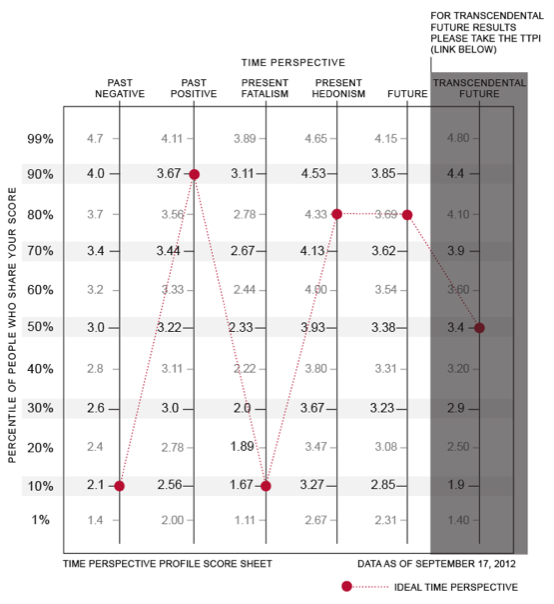
My own result hit close to the sweet spot. My self-evaluation about my time perspective recognizes that my hedonistic present anchors me and is also the imposition I have to work against. This is consistent with my Myers-Briggs XNXP, my Jungian puer aeternus complex, and my Big five extroverted, open to experience, and, non-neurotic personality type.
Importance of having a balanced time-perspective profile
Zimbardo & Boyd show that each of the six perspectives may have benefits, some much more than others. They also show that the costs associated with any one perspective may rise sharply if it is held in excess, and/or if it is out of balance with others of the six. Many of the book’s examples involve disturbed persons (e.g., addicts). But it also offers valuable more-general observations too. Here’s one that caught my eye: In discussing the faults of some executives who’d been running risky mortgage businesses not long ago, the authors find that “lack of balance between present and future orientations in both business and government is a well-worn path to disaster.”
As a result, Zimbardo & Boyd urge their readers to develop an “optimally balanced time perspective”:
“The ideal we want you to develop is a balanced time perspective in place of a narrowly focused single time zone. A balanced time perspective will allow you to flexibly shift from past to present to future in response to the demands of the situation facing you so that you can make optimal decisions.” twotheories blog
I say we are obviously as nature around us is. So that is also how our music is. But then our music must also be as we are (if two magnitudes both equal a third . . .). But then from our nature alone can I deduce how our music is (bolder men would say “how the cosmos is”). Arnold Scho?nberg
When I began, I had a very weak voice although with some melodic quality. I did not feel at all in touch with my body.
Through the use of the various sound practices, I occasionally developed a vague sense of being enlivened and having more energy, but this sensation came and went. About one year after beginning, in a group musical practice, I experienced feeling as though sound were coming, not from my vocal box, from my a place in the middle of my chest, near the pulmonary center. At the same time, I heard a ringing sound above the musical notes. These, I later found, were called overtones. I also felt a warm, expanding feeling from the heart and a kind of emotional release of joy.
This condition came and went for another 6 months. Then I had another “heart-opening” experience, which was felt as both massive pain and release of tension around the heart; I cried uncontrollably and felt I was coming apart.
Following this, I began to use the primary sound/music practice of finding a note that resonated in the heart, and singing that note every day for 15-20 minutes, using various mantric sounds. At the end of about 8 months, I could always find my way to this sound. At the same time, any catches in my throat, voice or breath that came up I began to re-experience as inhibitions and old memories that prevented me from intoning a natural sound (that is, saying who I was). report of a client of Dr. Klotz; The Key in the Dark: Self and Soul Transformation in the Sufi Tradition Neil Douglas-Klotz
A Beethoven string-quartet is truly . . . a scraping of horses’ tails on cats’ bowels, and may be exhaustively described in such terms; but the application of this description in no way precludes the simultaneous applicability of an entirely different description. -William James
What we call music in our everyday language is only a miniature from that music or harmony of the whole universe which is working behind everything, and which is the source and origin of nature. It is because of this that the wise of all ages have considered music to be a sacred art. For in music the seer can see the picture of the whole universe. (Pir H.I. Khan)
12. Nobody has ever seen a new species evolve.
Speciation is probably fairly rare and in many cases might take centuries. Furthermore, recognizing a new species during a formative stage can be difficult, because biologists sometimes disagree about how best to define a species. The most widely used definition, Mayr’s Biological Species Concept, recognizes a species as a distinct community of reproductively isolated populations–sets of organisms that normally do not or cannot breed outside their community. In practice, this standard can be difficult to apply to organisms isolated by distance or terrain or to plants (and, of course, fossils do not breed). Biologists therefore usually use organisms’ physical and behavioral traits as clues to their species membership.
Nevertheless, the scientific literature does contain reports of apparent speciation events in plants, insects and worms. In most of these experiments, researchers subjected organisms to various types of selection–for anatomical differences, mating behaviors, habitat preferences and other traits–and found that they had created populations of organisms that did not breed with outsiders. For example, William R. Rice of the University of New Mexico and George W. Salt of the University of California at Davis demonstrated that if they sorted a group of fruit flies by their preference for certain environments and bred those flies separately over 35 generations, the resulting flies would refuse to breed with those from a very different environment. 15 Answers to Creationist Nonsense
A linear concept of causality cannot adequately explain the interactions of a complex
system or Gestalt. The classical scientific paradigm is sufficient only for understanding
carefully isolated phenomena, where unidirectional cause and effect relationships occur
between interacting pairs, e.g., between one thing and another thing. – Lawrence Bale (Gregory Bateson, Cybernetics, and the Social/Behavioral Sciences)
Gregory Bateson: Am I using explanation in the same sense you are? I’m not sure. By explanation I would mean mapping a bunch of phenomena onto a tautology. The tautology being such that you cannot doubt the steps contained within it. The propositions you can doubt, but the steps you cannot. If P…then P…all right. This means that what is contained in the tautology is relations, only relations
Paul Ryan: Right.
Gregory Bateson: In order to explain, we build a tautology and map the things onto the tautology. And in order to strengthen our explanation we shall then go into what Peirce calls abduction and find other cases under that tautology.
(Metalogue: Gregory Bateson, Paul Ryan via earthscore.org)
In a computer, which works by cause and effect, with one transistor triggering another, the sequences of cause and effect are used to simulate logic. Thirty years ago, we used to ask: Can a computer simulate all the processes of logic? The answer was “yes,” but the question was surely wrong. We should have asked: Can logic simulate all sequences of cause and effect? The answer would have been: “no.” (Gregory bateson, Mind and Nature)
I believe that consciousness and its contents are all that exists. Spacetime, matter and fields never were the fundamental denizens of the universe but have always been, from their beginning, among the humbler contents of consciousness, dependent on it for their very being.
The world of our daily experience—the world of tables, chairs, stars and people, with their attendant shapes, smells, feels and sounds—is a species-specific user interface to a realm far more complex, a realm whose essential character is conscious. It is unlikely that the contents of our interface in any way resemble that realm. Indeed the usefulness of an interface requires, in general, that they do not. For the point of an interface, such as the windows interface on a computer, is simplification and ease of use. We click icons because this is quicker and less prone to error than editing megabytes of software or toggling voltages in circuits. Evolutionary pressures dictate that our species-specific interface, this world of our daily experience, should itself be a radical simplification, selected not for the exhaustive depiction of truth but for the mutable pragmatics of survival.
If this is right, if consciousness is fundamental, then we should not be surprised that, despite centuries of effort by the most brilliant of minds, there is as yet no physicalist theory of consciousness, no theory that explains how mindless matter or energy or fields could be, or cause, conscious experience. source: Donald Hoffman Cognitive Scientist, UC, Irvine; Author, Visual Intelligence | Edge,org
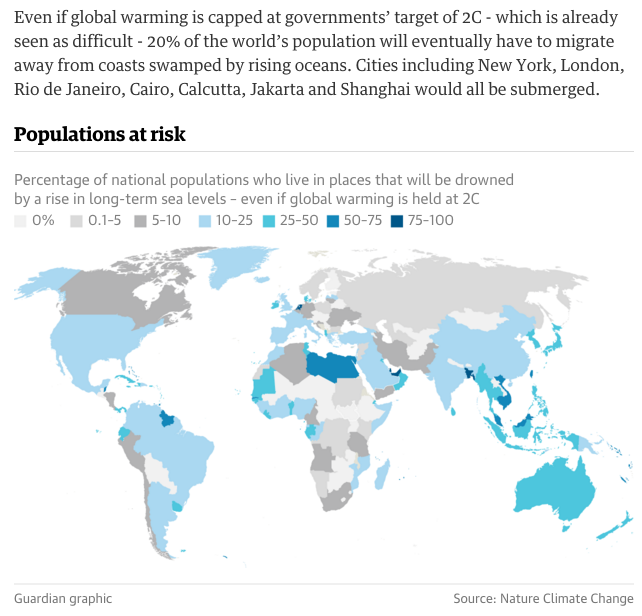
Cleveland Heights, Ohio, USA, is 950 feet above sea level. We could probably take tens of thousands of climate refugees. I do not know what the effect of climate cahnge will be on the great lakes. Hey, I can look it up!
Forbes Magazine tells me “the great lakes are benefitting from climate change.”
Nature Geoscience, February 8, 2016 – Cooling and societal change during the Late Antique Little Ice Age from 536 to around 660 AD
Glacial Isostatic Adjustment (i.e.,Glacial Rebound): The Great Lakes basin is, in effect, tilting over time as the result of the land rebounding after regional glaciers retreated about 10,000 year ago. The southwestern end of the basin is falling relative to the center of where the past glacier existed. This makes water levels in Milwaukee, Wisconsin, for example, appear to be rising. At the same time, water levels in the northeastern portion of the basin (e.g., Georgian Bay, Ontario) appear to be dropping. This rebound accounts for about one foot of water level change (rising or dropping) in a person’s lifetime (International Upper Great Lakes Study 2009).
Climate change: Annual average air and water temperatures are rising and future climate models
project continued warming, which contributes to higher rates of evaporation. Projected future
precipitation amounts, rates, and annual variability in timing of wetter and drier periods vary by
model.
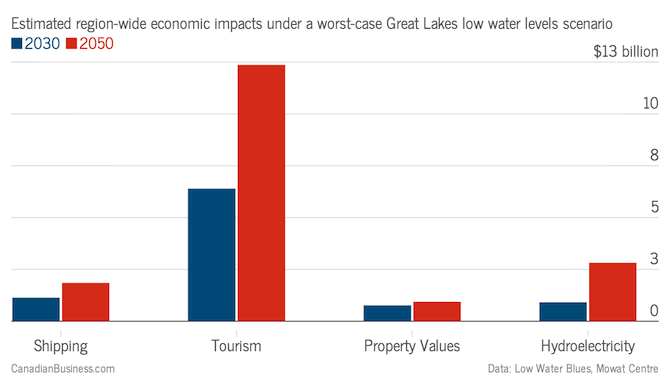
But what does all of this mean for water levels in the Great Lakes? This is an important question; after all, our current infrastructure around the Lakes, from ports and canals to beaches and boardwalks, were designed and built based on the water levels experienced throughout the Twentieth Century. This is a far more complicated question than the one facing coastal cities along the oceans that are contending with sea level rise due to glacial melt and thermal expansion of water. Water levels in the Great Lakes will be determined almost entirely by levels of precipitation and evaporation, as well as by the quantities of water removed from the watershed through consumption or diversion. A further consideration is that water levels are controlled at two points; at the outflow from Lake Superior, and at the outflow from Lake Ontario, as regulated by the International Joint Commission. This suggests that the Lake Superior, as the upstream lake, will serve as the bellwether for the rest of the lakes. How Will Climate Change Affect the Great Lakes? Earth Institute, Columbia Univ.
According to [Francisco] Varela, an autonomous system can be precisely defined as a system that has organizational closure and operational closure (Varela 1979, pp. 55-60). The term ‘closure’ does not mean that the system is materially and energetically closed to the outside world (which of course is impossible). On the contrary, autonomous systems are thermodynamically far from equilibrium systems, which incessantly exchange matter and energy with their surroundings. ‘Organizational closure’ describes the self-referential (circular and recursive) network of relations that defines the system as a unity. At any given instant or moment, this self-referential network must be maintained, otherwise the system is no longer autonomous and no longer viable in whatever domain it exists. ‘Operational closure’ describes the recursive, re-entrant, and recurrent dynamics of the system. The system changes state on the basis of its self-organizing dynamics (in coupling with an environment), and the product of its activity is always further self-organized activity within the system (unless its operational closure is disrupted and it disintegrates).7 Biological examples abound—single cells, microbial communities, nervous systems, immune systems, multicellular organisms, ecosystems, and so on. Such systems need to be seen as sources of their own activity, and as specifying their own informational or cognitive domains, not as transducers or functions for converting input instructions into output products. In other words, the autonomous nature of these systems needs to be recognized.
Neurophenomenology: An Introduction for Neurophilosophers (pdf)
Evan Thompson, Antoine Lutz, and Diego Cosmelli
This video is new to me and it provided a big wallop.
In my framing of fortuity, contingency and fragility, I have only roughed out some of the implications for music making. B.E. helps move this forward during a really essential 15 minutes.
He mentions Stafford Beer. (He, along with Ralph Stacey, Gordon Pask, and Gregory Bateson, probably did the most to extend cybernetics to human domains in the first wave of cybernetic thinking. Largely from Beer and Stacey we gain the concept of soft systems, and from Beer we gain the Viable Systems Model (Trevor Hilder’s presentation – pdf).)
Krishnamurti said that “to be” is to be related. But relationship can be very painful. He said that you have to think and feel out all your mental processes and work them through, and then that will open the way to something else. And I think that is what can happen in the dialogue group. Certain painful things can happen for some people; you have to work it all out.
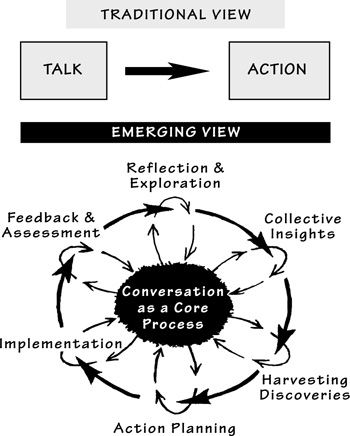
This is part of what I consider dialogue—for people to realize what is on each other’s minds without coming to any conclusions or judgements. In a dialogue we have to sort of weigh the question a little, ponder it a little, feel it out. You become more familiar with how thought works.
It isn’t necessary that everybody be convinced to have the same view. This sharing of mind, of consciousness, is more important than the content of the opinions. You may find that the answer is not in the opinions at all, but somewhere else. Truth does not emerge from opinions; it must emerge from something else—perhaps from a more free movement of this tacit mind. David Bohm, For Truth Try Dialogue
Proprioception (PRO-pree-o-SEP-sh?n), from Latin proprius, meaning “one’s own”, “individual,” and capio, capere, to take or grasp, is the sense of the relative position of neighboring parts of the body and strength of effort being employed in movement.
In my view, “thought” is a kind of ruler that imposes its rules, hence it suppresses the spontaneous emerge of natural coherence. Any imposition by “thought”, such as a particular ideology, religion, or a predetermined topic, or having some kind of agenda, would ultimately block the natural flow of the dialogue which must be free to find its own way towards coherence. It cannot be brought about by conscious attempts.
“Thought” does have an important role to play; not as a ruler but more as a servant: it should serve to carry out the implications of what is revealed by the natural coherence that emerges out of the chaos resulting from anarchistic dialogue. So, the first thing “thought” must do is to become aware of its purpose and stop suppressing the very thing it should serve. But it is a rare ruler who voluntarily becomes a servant. William van den Heuvel, Dialogue and Anarchy
David Peat recounts: “In an earlier posting we saw how Bohm believed that the laws of physics were contained within his physical body. On occasion he experienced this directly. Once when working on an equation he felt a strong sensation within his body and, as he continued to work, a counter sensation. These sensations appeared to correspond directly to the mathematics he was writing down.
Bohm spoke to Einstein about this who told him that when working on his field equations he would squeeze a hard rubber ball and note the sensations in his arm.
When thinking Bohm also had the habit of tossing a group of coins from one hand to another. This annoyed Robert Chambers who occupied an office separated by a lightweight partition from Bohm’s. Month after month he had to put up with the sound of Bohm’s pacing up and down and the jingling of coins.” via The Bohm Documentary
Three types of incoherence of thought:
1- Thought is oblivious to its being participative.
2- Thought stops tracing reality and autonomously executes like a program.
3- Thought establishes its own abductions, frames of reference, and methods for fixing problems, without also deconstructing how thought is a feature of the problem
“The actual order (the Implicate Order) itself has been recorded in the complex movement of electromagnetic fields, in the form of light waves. Such movement of light waves is present everywhere and in principle enfolds the entire universe of space and time in each region. This enfoldment and unfoldment takes place not only in the movement of the electromagnetic field but also in that of other fields (electronic, protonic, etc.). These fields obey quantum-mechanical laws, implying the properties of discontinuity and non-locality. The totality of the movement of enfoldment and unfoldment may go immensely beyond what has revealed itself to our observations. We call this totality by the name holomovement.” David Bohm
(2)
In the free play of thought, creative intelligence responds to opposition and contradiction with new proposals.” David Bohm
For me and my research into serendipity the notion of hidden connectedness yields to the notions of uninstantiated contingency and radial contingency. In the free play of uninstantiated contingency, sensitive (to radial contingency,) intelligence responds to possible fortuities and unknown potentials with new conjunctions.
Radial contingency means the possibilities that are located at the end of the spokes of a observer/participant’s awareness, as this awareness radiates outwardly toward other locations of awareness.
“The quantum field contains information about the whole environment and about the whole past, which regulates the present activity of the electron in much the same way that information about the whole past and our whole environment regulates our own activity as human beings, through consciousness.” David Bohm
Also, my experiential aesthetics being rooted in a theorization of generative learning are deeply informed by Bohm’s conception of enfoldment.
“Everybody has seen an image of enfoldment: You fold up a sheet of paper, turn it into a small packet, make cuts in it, and then unfold it into a pattern. The parts that were close in the cuts unfold to be far away. This is like what happens in a hologram. Enfoldment is really very common in our experience. All the light in this room comes in so that the entire room is in effect folded into each part. If your eye looks, the light will be then unfolded by your eye and brain. As you look through a telescope or a camera, the whole universe of space and time is enfolded into each part, and that is unfolded to the eye. With an old-fashioned television set that’s not adjusted properly, the image enfolds into the screen and then can be unfolded by adjustment.” David Bohm
Loss of a person, of a close frriend or of a family member, presents a challenging process which won’t let go as it impels me through its requisite travail.
At the same time, the outward conventions of concern and courtesy basically allow for a restoration of human contact in the collective terms of concern and courtesy, and, sure, in the terms of grief and mourning.
These expressions are helpful, even as the expressed kindnesses and concerns seem to me to reach around the really bare, and profoundly forward-pitched facts. Of course, I would do the same thing, in approaching somebody’s loss, in approaching a ‘death in the family.’ Except, at the same time, I would be always holding back my usual, or my habitual, curiosity.
I would reign in my researcher’s soul.
What is actually going on?
I previously mentioned, or I think I did so, that in the weeks between meeting Ken for the first time and our second meeting, he reported to me that he had read my entire web site and blog. At the time he made this report, I didn’t know really what kind of ‘reader’ was Ken. Still, I was very impressed because he had begun what we came to call, ‘the forensics;’ and I had begun the same process. Furthermore, apparently, we shared this similarity, we both knew more data is better than both a little data, and, the thin positive capability through which a little data and bad guesswork are joined together.
Gone! Okay, what is actually going on with you Stephen? This is the question that can be addressed to me.
I do bring in, and try to warmly receive, the heartfelt substitutions for this non-obvious question. Oh, it was not a non-obvious question to Ken. When my mother passed away in early 2012, he asked me,
“What is going on?”
And, he kept asking. I’ll miss his researcher’s tenacity! If somebody doesn’t ask me this question, he or she is missing the boat. I’m not missing it, I’m in it.
I have put much of the actual goings on ‘with me’ in the aftermath of my loss, ‘out there,’ here, on my blog. (This blog is iteration number three, begun five months after meeting Ken in the fall of 2004.)
To review:
1. Shocked!
Friendship
2. the LOVE BASIS
3. COMBINATORIAL questing
4. active DECONSTRUCTION
5. the ANIMA PROBLEM
6. interlude: what you don’t know, give into
7. interlude: process and reality
8. NEGATIVE CAPABILITY, Irony
Ken would have appreciated why the number of posts is eight. Hey, I’m throwing out clues here!
He and I agreed on a great great deal, although as I have tried to make clear, Ken was entangled by his enthusiasms, whereas I am mostly afraid of my own; (so, I trained myself to be a fallibilist.)
Also, I feel as if I need to be careful. But, it isn’t also true that anybody should feel he or she is to be a second fiddle. Heck, go for it. Life is unpredictable. And, you’re unlikely to figure out in advance when your last breath is steaming down the tracks.
Close relations are my second highest value–and are so for reasons I’m able to express. Ask me. Go for it.
The Green Man (Stephen Calhoun
Ken and I spent a lot of time deconstructing what to us–to maybe only us–was the single most bloody problem in the ‘scape of modernity, (that:) the fundamental problem is relational incapacity, not deficits in rationality or critical thinking.
Note, the structure goes from Shock to Negative Capability. It goes from oh no, shit! to soul!
Yes, it was terrific and quite medicinal, perhaps even karmically medicinal, to feel really extremely thoroughly known by Ken, yet, I’ve mapped out the foundation to be: going from the LOVE BASIS to the COMBINATORIAL. Ken and I were sensemakers, this is what we did over many thousands of hours. Why?
What is actually going on?
Why? …such a good question. We never discussed explicitly dialogical recognition (Charles Taylor,) yet when we together took up the cause of the noetic public library we sorted out a deep congruence about the micro problems come to coalesce around the macro problems of–within the pragmatics of praxis in a library–reification, instrumentalism, objectification, dehumanization, and, well, how it is, apparently, easy to rip the fucking heart of a library out of its cavity, and place in this cavity a bunch of 3D printers.
Similarly, most societal problems at the scale of the kind of civics citizens actually can effectively practice, are initiated in the first order by the atrophy of the human ability to actively know one other. Ken and I understood our diagnosis would deconstruct this order of knowing. Then, for the sake of reanimating the civic heart and civic capacity for making sense, we worked over how in a city or in a library how citizens might collaborate on a new, deeper (3rd) order of interpersonal and intrapersonal knowing cum relationship.
In the light of the ideal of authenticity, it would seem that having merely instrumental relationships is to act in a self-stultifying way. The notion that one can pursue one’s fulfilment in this way seems illusory, in somewhat the same way as the idea that one can choose oneself without recognizing a horizon of significance beyond choice. Authenticity a picture of what a better or higher mode of life would be, where better and higher are defined not in terms of what we happen to desire or need, but offer a standard of what we ought to desire. (Charles Taylor)
Ken and I spent zero time slapping each other on the back when we discovered, for example, we both were familiar with Paolo Freire. It was all matter-of-fact because it is who you are, not what you know, and, so, study for the love of the quest. Train first! Deploy, drill down, together stick our hands in the muck.
What is actually going on?
When we turned this around, our critical chops came to meld Ken’s learned Saturnian thrust with my edge-seeking Promethean swing. Ken possessed this aspect, one that was like the boy with a hammer, the boy who would swing his hammer at everything; and, I, an actual complexed puer, possessed a kind of penetrating Apollonian cynicism, and, also I, a Batesonian, was able to stand back a bit. (Well, I didn’t want to get accidentally rapped by the hammer.) Yet, when we got going. . .
we’d cover stuff very very quickly. ‘Marx was not even a horrible psychologist, yet Russell was on the money in noting Marx was a Christian heretic.’ ‘Jung only had an inkling that he had birthed a psychology and its daughters from his lapsed Lutheran brow, and that his psychology’s wider applications were somewhat covertly undermined by this creation story.’ ‘There are short paragraphs in the Tibetan Canon, or the best haiku, which could right now replace and improve every word Ken Wilber has ever scribbled.’
‘cover’ doesn’t mean getting it correct.
Ken, by the way, fulfilled the demands of authentic relationship with many many people. He and I were in a synergistic profoundly complementary relationship, and spent no time gratuitously or otherwise aggrandizing how great was our relationship, except we did once briefly consider some of the contingencies and fortuities and errors which had to slowly collapse, like a holy wave function organizing its effective reality, or ‘reality,’ and do so over two lifetimes, all for the sake of being able to efficiently and cleanly deploy together the practical and/or explosive tools our dialectical instigations, spontaneous poetics, and channeled intuitions, came to evoke and muster.
Did it help our effort that we happened to have both traveled through some of the same ideational and metaphysical lands? See: Interlude #3 tomorrow.
Nevertheless, our learned congruency was like a picture pasted to the jig pieces of a puzzle. With time, and it still is going to take time no matter what, two people working together can piece the puzzle together without having to refer to the ‘parted’ picture on the surface of each piece.
What Ken and I disagreed about: particular ramifications. For example, the ramifications implicitly of this perspective:
Ken, you should just give up trying to trick me.
Ken respected where I could not go. I had occasion to remind him earlier this year that “such respect then leads irrevocably to my Promethean liberation of Astrology and Psycho-astrology,” (and how I came to amputate various fixities from their thin causal relations.)
I had planned to take him (this summer) through The Reduced Bateson Set. (Oh well.) We had begun to recast some of the developmental fixations in learning theorizing and in specific theories, like the theory of my friend, David Kolb. Obviously, to where the action learning of our entwined dialectical picking and drumming would have led to, is about as unknowable as an unknown could be.
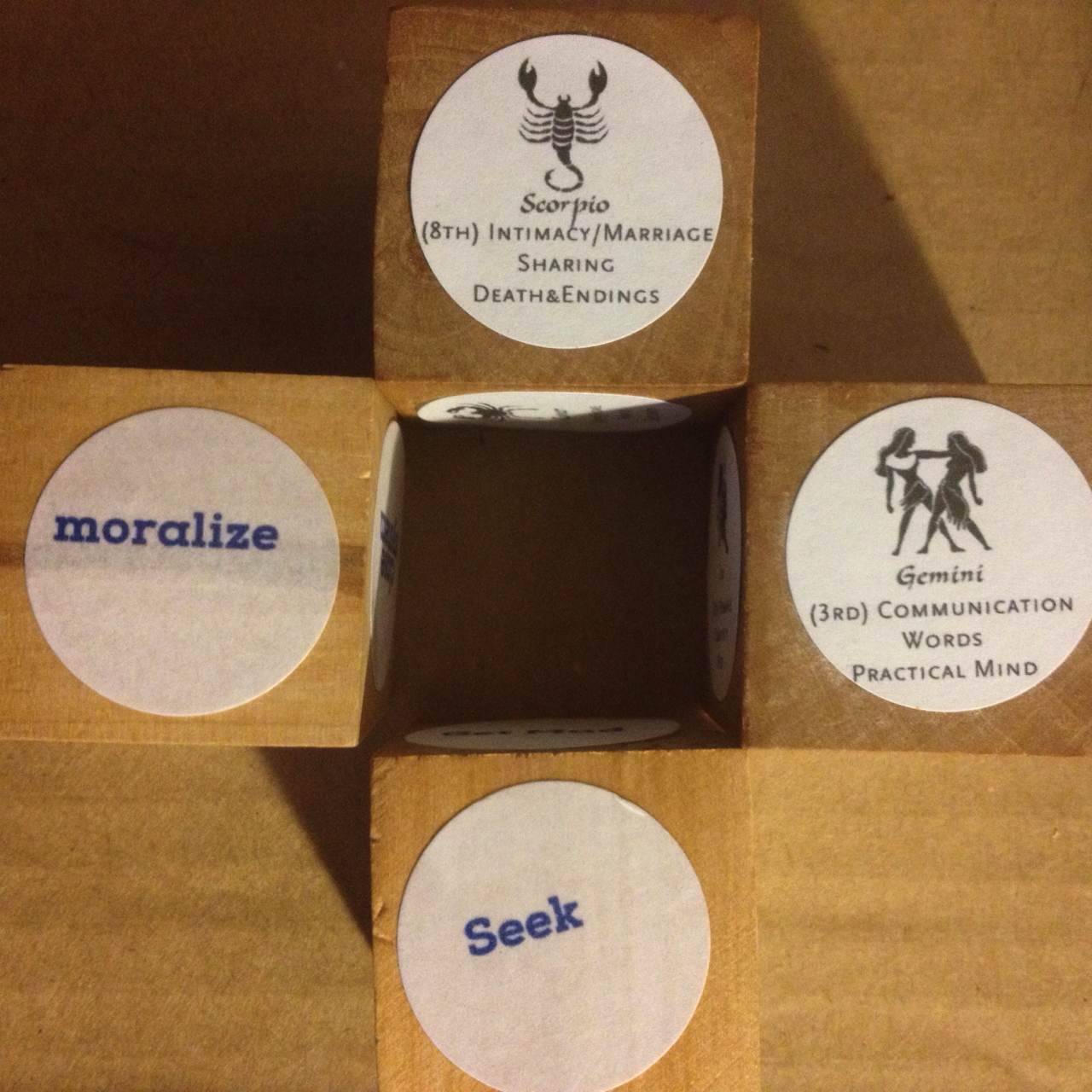
I had submitted a Cube-O-Probe, as a visual poem, to House Organ. Ken rarely specified the ways in which our workplay was influencing his numerous other projects. But, he was a boy with a hammer! He took his set #2 of Cubes and fearlessly interpreted their message on behalf of astrologers, poets, and nieces.
One deep congruency we arrived at, we came to right at the beginning. Love basis.
Another lesser, and vital congruency, brought forth one of the essential fundamentals able to support our mindful and creative travels: as it happens, an exquisitely sensitive humane esotericist breaks bread with a mercurial edge-seeking flatlander because the whole cause of inverting assumptions and sometimes having to mulch them is shared and equally served by two radically different sensibilities–except for, as Rumi noted, our “fleshy hearts.”
We traveled and never went anywhere. We made a road trip to the Target in North Olmsted for the sake of a veteran who had just rented a crib in Lakewood but didn’t have a bed.
h/t Lakewood Observer
We made a bunch of trips to Wadsworth in support of our fellow traveler, Daniel and his public library.
“Ken, would you please try to keep at least one hand on the wheel?”
When I had reason to remind Ken that I am, by disposition, a “deep ironicist,” he told me this assertion perplexed him. I told him,
“Come on Ken, you’re the one who titled me, Dr. Puck.”
Then, I explained to him what imperatives are driven by chops, negative capability, good/bad fortune, large collections of devices and heuristics, multitudes of perspectives, plus the ability to rappel down to the “meta,” and, I went on,
“then there are also all those just-in-time intuitions blowing into your scheme like neutrinos stream through the material world, except you and me grab at ’em and we bring the intuition back alive, from wherever was its ‘wild,’ and you stick ’em to your wall, They always seem to stick.”
Dear Mr. Harrison
the problem of the Ufos is, as you rightly say, a very fascinating one, but it is as puzzling as it is fascinating; since, in spite of all observations I know of, there is no certainty about their very nature. On the other side, there is an overwhelming material pointing to their legendary or mythological aspect. As a matter of fact the psychological aspect is so impressive, that one almost must regret that the Ufos seem to be real after all. I have followed up the literature as much as possible and it looks to me as if something were seen and even confirmed by radar, but nobody knows exactly what is seen. In consideration of the psychological aspect of the phenomenon I have written a booklet about it, which is soon to appear. It is also in the process of being translated into English. Unfortunately being occupied with other tasks I am unable to meet your proposition. Being rather old, I have to economize my energies.
Confusions about probability cause probable errors. A possible conjunction supposes a chance of eventuation and has a chance of happening, yet after it has happened its chances of happening collapse to unity by virtue of the happening having occurred.
If/When
When Jesus is Lord of your life, there are no coincidences. Dick Luchtenberg, Journey to Freedom
“It is my purpose to show that it is logically impossible to ascribe any power to chance whatever… If chance exists in its frailest possible form, God is finished… If chance exists in any size, shape or form, God cannot exist.” R.C. Sproul. 1994. Not a Chance: The Myth of Chance in Modern Science and Cosmology
“If one likes one could ascribe this randomness to God, but it would be a very strange kind of intervention: there is no evidence that it was directed toward any purpose. Indeed if it were, it would, by definition not be random.” Stephen Hawking
Time to consult the Cube-O-Probe. Probe, in what direction might fruitful territory be discovered for further investigation of the aspects of coincidence and a priori requisite in the quiddity of eventuation?
Comment: The Probe suggests an obvious investigatory dialectical vector between the practical consideration of the marriage of the apparently opposite chance and foreordained, with the completely knotty problem of seeking essential morality within this same interplay. Here also is the ping-ponging between theological and Newtonian determinism, and maybe this could give into finding dual forms for morality. Once again the Cube-O-Probe charts the way!
Doxastic commitment, or “soul in the game”: You can only believe predictions and opinions by those who committed themselves to a certain belief, and had something to lose, in a way to pay a cost in being wrong. Nassim Taleb (from the Anti-Fragile Glossary)
“The general principle of antifragility, it is much better to do things you cannot explain than explain things you cannot do.” – Nassim Taleb
coincidence (OED)
[a. F. coïncidence, L. type *coincidentia: see coincident and -ence.]
1. a.1.a The fact or condition of being coincident; the occupation of the same place or part of space.
1626 Bacon Sylva (1677) §224 There can be no Coincidence in the eye, or Visual Point. 1715 Cheyne Philos. Prin. Relig. (J.), The coincidence of the planes of this rotation with one another, and with the plane of the ecliptick. 1831 Brewster Newton I. x. 222 The singleness of the picture arises from the coincidence of the two pictures. 1870 R. M. Ferguson Electr. 33 This want of coincidence of the points of vertical dip and of maximum intensity.
fig. or transf. 1650 Fuller Pisgah v ii. §5 By a casuall coincidence some straggling words of the Athenians may meet in the mouths of the veriest Barbarians. 1847 Emerson Repr. Men, Plato Wks. I. 304 The rare coincidence, in one ugly body, of the droll and the martyr.
b.1.b (with pl.) A case of coincidence.
1837 Whewell Hist. Induc. Sci. (1857) I. 153 The method of making visual coincidences. 1880 Adams in Times 28 Dec. 10/2 The new line-spectra, the real basic lines of those substances which show coincidences.
2.2 Occurrence or existence at the same time; simultaneous occurrence or existence.
1650 Fuller Pisgah iii. iii. §8 There might be a casuall coincidence of this feast and his presence at Jerusalem. 1681 More Expos. Daniel 257 There is a Coincidence, at least of time. 1722 Susanna Wesley in Eliza Clarke Life (1886) 130 There hardly ever was a greater coincidence of unprosperous events in one family. 1837 H. Martineau Soc. Amer. III. 297 A happy coincidence of outward plenty with liberal institutions. 1878 Huxley Physiogr. xx. 342 The coincidence of twelve by the clock with noon by the sun-dial?is exact only four times in the year.
3. a.3.a Exact agreement or correspondence in substance, nature, character, etc.
1605 Bacon Adv. Learn. ii. v. §3 Is there not a true coincidence between commutative and distributive justice, and arithmetical and geometrical proportion? a?1716 South Serm. VII. v. (R.), Those who discourse metaphysically of the nature of truth?affirm a perfect coincidence between truth and goodness. 1831 Brewster Newton (1855) II. xxiv. 352 The coincidence of the religious views of Sir Isaac Newton with those of John Locke. 1876 Grote Eth. Fragm. iii. 58 These two ends of action are sometimes found in conflict, but more frequently in coincidence.
b.3.b (with pl.) An instance of such agreement or correspondence.
a?1661 Fuller Worthies (1840) I. 201 A local coincidence, which?cannot be paralleled. 1736 Butler Anal. ii. vii. 356 Evidence arising from various coincidences. 1790 Paley Horæ Paul. Rom. ii. 13 Such coincidences may fairly be stated as undesigned. 1867 Freeman Norm. Conq. (1876) I. App. 724 A remarkable series of undesigned coincidences in favour of the belief.
4.4 A notable concurrence of events or circumstances having no apparent causal connexion.
a?1682 Sir T. Browne Let. to Friend (Camelot ed.) 185 That he should also take King Francis prisoner upon that day [of his nativity], was an unexpected coincidence. 1821 De Quincey Confess. Wks. 1863 I. 96, I felt it at the time?as a singular coincidence, that twice, etc. 1823 Byron Juan vi. lxxviii, A ‘strange coincidence,’ to use a phrase By which such things are settled now-a-days. 1829 Scott Guy M. Introd., The fact, if truly reported, is one of those singular coincidences which occasionally appear. 1865 Livingstone Zambesi xix. 378 It might be only a coincidence.
5.5 Of persons: Agreement or concurrence (in opinion or sentiment).
1795 Hull Advertiser 28 Nov. 3/1 Mr. Sturt?expressed his co-incidence with the sentiments of [the Petition]. 1800 Wellington in Owen Disp. 647 You are already apprized of my entire coincidence in your opinion. 1800 Syd. Smith Six Serm. 60 A modest coincidence with received opinions above our faculties.
†6.6 Falling together, conjunction blending. Obs.
c?1645 Howell Lett. (1650) II. 88 The Latine tongue, with the coincidence of the Goths language and other northern peeple.
7. a.7.a Physics. The indication of the occurrence of ionizing particles in two or more detectors simultaneously (see quot. 1958). Also attrib. Cf. anti-coincidence.
1930 Physical Rev. XXXV. 651/2 Enormously increased resolving power can be obtained by the requirement of multiple instead of paired coincidences. The attainment of very great freedom from accidental coincidences is of greatest importance [etc.]. Ibid. 652/1 Automatic recording of the amount of the penetrating radiation coming from particular areas of the sky, using two tube-counters and a special ‘coincidence circuit’. 1938 R. W. Lawson tr. Hevesy & Paneth’s Man. Radioactivity (ed. 2) xxv. 280 Insertion of sheets of lead between the counters only slightly diminishes the number of simultaneous discharges (coincidences), and this proves that we are here confronted?with cosmic rays. 1940, etc. [see anti-coincidence]. 1958 Van Nostrand’s Sci. Encycl. (ed. 3) 369/1 A true coincidence is one that is due to the detection of a single particle or of several genetically related particles. An accidental, chance, or random coincidence is one that is due to the fortuitous occurrence of unrelated counts in the separate detectors.
b.7.b Computers. Equivalent signals received simultaneously in an electronic circuit; the reception of such signals. Also attrib.
1947 Rev. Sci. Instruments XVIII. 907/1 In order to reduce chance coincidences to a minimum, it is necessary to use a coincidence circuit. 1948 Ibid. XIX. 565/2 Methods can be found for modulating one of the E.M.T.’s?so that the E.M.T.’s themselves form a coincidence or anticoincidence system. 1950 C. B. Tompkins et al. High-Speed Computing Devices iv. 37 An electronic gate is a circuit with a single output and two (or more) inputs so designed that an output signal is produced when, and only when, input signals are received on both (or on a particular set of) input leads. Such circuits are variously known as gates, coincidence circuits, Rossi circuits, or logical and circuits. 1953 A. D. & K. H. V. Booth Automatic Digital Calculators xi. 111 Coincidence sensers. In computing machine design it is frequently necessary to have available means for ascertaining the identity of two quantities. 1964 M. J. Pedelty in Tou & Wilcox Computer Sci. x. 248 The essence of the system?is that signals are ‘broadcast’ on a ‘to-whom-it-may-concern’ basis. Coincidence gates and delays can then be used to detect certain pulse patterns from the ‘broadcast alphabet’.
And they will gather by the well,
its dark water a mirror to catch whatever
stars slide by in the slow precession of
the skies, the tilting dome of time,
over all, a light mist like a scrim,
and here and there some clouds
that will open at the last and let
the moon shine through; it will be
at the wheel’s turning, when
three zeros stand like paw-prints
in the snow; it will be a crescent
moon, and it will shine up from
the dark water like a silver hook
without a fish–until, as we lean closer,
swimming up from the well, something
dark but glowing, animate, like live coals–
it is our own eyes staring up at us,
as the moon sets its hook;
and they, whose dim shapes are no more
than what we will become, take up
their long-handled dippers
of brass, and one by one, they catch
the moon in the cup-shaped bowls,
and they raise its floating light
to their lips, and with it, they drink back
our eyes, burning with desire to see
into the gullet of night: each one
dips and drinks, and dips, and drinks,
until there is only dark water,
until there is only the dark.